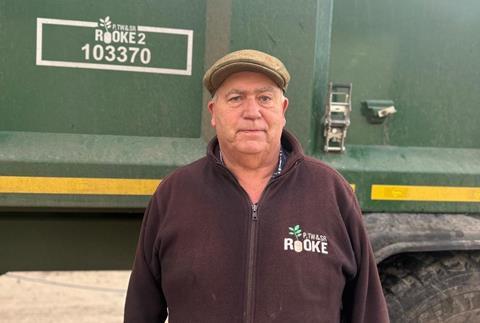
NFU Potato Policy Group chair Tim Rooke stresses the importance of growing potatoes with a clear understanding of your market as climatic conditions become less predictable and production costs increase
This year has reminded us just how unpredictable potato growing can be.
We got off to a great start with early planting and good soil conditions, but then the rain more or less stopped. Apart from the odd shower, it stayed dry right through to harvest. Only about 30 per cent of our land can be irrigated, and even that was restricted when river levels dropped. The crop grew fast and finished early. The potatoes are of good quality, but yields have come in at about 1-1.5 tonnes below contract. We finished lifting by 18 October, which is the earliest we’ve ever been.
Last year couldn’t have been more different. It was wet from start to finish, and we didn’t start planting until late April. The growing season was shorter and slower. Yet, despite being complete opposites, both years ended up producing very similar yields. It shows just how much the weather can swing from one extreme to the other and how little “average” there is any more.
At a national level, that variation has fed straight into the market. In 2024, a tight supply pushed free-buy prices up to £600-£700 a tonne. This year, there’s hardly been any free-buy trade at all. It’s not a disaster, just a reminder of how quickly the balance between supply and demand can shift.
That’s really the point I want to make: grow for your market, not for one that isn’t there.
I’m not suggesting anyone should back away from growing potatoes. Quite the opposite. But it’s important that what we put in the ground has a clear market to go to. Potatoes are an expensive crop to grow and are getting more so. Once you’ve added up the production costs of fertiliser, fuel, power, storage and labour, it’s not unusual to be looking at spending £2,500 to £3,000 an acre before you sell a single tonne.
Around two-thirds of the national crop is grown on contract, which gives some stability to both growers and processors. The rest is sold on the open market, and that flexibility still matters. It keeps trade moving and allows growers to respond quickly when supply and demand shift.
Whatever route you take, the same rule holds true. It pays to know your market. Understanding who you are growing for, what they need, and when they need it will always serve you better than putting in extra acres and hoping demand will catch up. Clear planning and regular communication throughout the supply chain build confidence and make the whole sector stronger.
With cereal prices under pressure and support payments more or less gone, more land is coming available for potatoes again. For established growers, that opens doors, but expansion needs to be done for the right reasons. Taking on extra ground only makes sense if there’s a secure market for the crop.
That said, the sector itself remains in good shape. British growers are adaptable, technically skilled and resilient. Our processors and packers continue to invest in storage, grading and innovation. There’s steady demand for high-quality British produce, backed by a strong reputation for traceability and consistency.
There are, however, a few practical issues that could make a big difference. Access to water is one of them. A more joined-up approach to irrigation and storage would help growers cope better with the drier seasons we now seem to get more often.
The other is plant protection. We’ve lost several long-standing products in recent years, often without suitable alternatives. Nobody is arguing for anything unsafe, but we do need a balanced, science-based approach that recognises the risks we take and the standards we work to. If the UK wants a strong potato sector, we need the tools to do the job properly.
The future for British potatoes is still bright. We’re seeing progress in efficiency and sustainability, and we continue to deliver a product that consumers trust and value. The challenge now is to keep matching what we grow to what the market actually needs, and to keep that balance right across the supply chain.
So as plans start for 2026, my advice is to grow for your market. Focus on producing the right crop for your customers, manage costs carefully, and keep building those long-term relationships.
GB Potatoes member Tim Rooke is chair of the NFU Potato Policy Group and vice-chair of the NFU Horticulture and Potatoes Board. He farms in partnership with his brother and son in North Yorkshire, growing around 600 acres of processing potatoes for the chipping and crisping markets, including King Russet, Pentland Dell, Lady Rosetta, Brooke and Taurus.