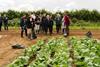
With a new Organic Action Plan for England on the horizon, Julia Bottoms reports on what the sector wants to see – and whether promises can turn to policies

With renewed commitment from ministers, the sector feel generally optimistic about the plan

With renewed commitment from ministers, the organic sector is generally optimistic about the plan

Image: Riverford.co.uk

It’s been almost a quarter of a century since the last Labour government published an Organic Action Plan for England in 2002. Since then, consumer demand for organic food has grown for 14 consecutive years, pushing the sector’s value to a record £3.9 billion, according to Soil Association Certification’s Organic Market Report 2026. 

Now, Westminster finally appears ready to act. Speaking at Groundswell Festival in June, then Defra secretary Emma Reynolds (who has since been replaced by Dame Angela Eagle) appeared to confirm that work on a new organic action plan is under way. 

Organic leaders believe the timing reflects a broader shift in government thinking. Rob Haward, CEO at organic veg box company Riverford, says: “There’s recognition from the government that in the face of degradation of our soils and depletion of nature and wildlife […] we need to think of ways to farm that are more protective.” He adds that climate change and geopolitical instability are also driving the need for more resilient farming systems.

As for the public, increased demand is due to “increasing focus on healthy food produced in ways that are kind to the environment,” according to Gareth Morgan, head of farming policy at the Soil Association. However, as UK production currently stands, reliance on foreign imports continues to offshore organic’s environmental and economic benefits. The charity says just 1.6 per cent of UK food sales are organic, trailing well behind other European markets.

“If we don’t grasp this opportunity, the EU will happily supply growing consumer demand in this country,” Morgan continues. “We don’t want to be importing to meet increasing demand for organics when we could be producing much more of it ourselves.” 

Sector wish list

There’s been conjecture as to what the Organic Action Plan might include, but key priorities from the industry itself have started to emerge. Calls for a target to increase the proportion of England’s organic farmland from three per cent to 10 per cent were renewed in January, in an open letter signed by 18 environmental and farming organisations. However, Steve Clarkson, chief executive of organic certification body Organic Farmers & Growers  (OF&G), is uncertain on its terminology. “I think Defra are keen to avoid the use of the word ‘target’,” he says. “Whether they’d call it a target or ambition is neither here nor there.”

Supporting farmers through the two-year organic conversion period is seen as another of the biggest tests of the plan. “It would be great to get to a situation where farms wanting to convert to organic had effective support over a period of say, five years,” says Morgan. However, support must go beyond being purely financial, adds Haward. “There’s so much experience already in the sector. Providing peer-to-peer support, technical skills building, and training grants would be really helpful.”

Organic food within public procurement could also be another lever to boost local economic resilience, public health and the environment. “I’d love to see a 10 per cent target for public procurement to get us started,” says Haward.

While organic food currently makes up only a small proportion of the meals served in schools, hospitals and other public institutions, research from sustainable food alliance Sustain found that getting more organic produce into schools generated £9.46 for local economies, public health and  the environment, for every £1 of added investment. 

There are also calls for government support for data gathering. “There’s a lot of data out there that could still be collated and would certainly aid development,” says Clarkson. “If we could establish a data hub, that would be really good. Knowing what’s coming into the UK, when it’s coming, and what products could be filled by domestic production is key.”

Beyond funding 

Other than funding, government recognition that organic can and should play a role in Britain’s future is one of the most important points of action, according to Haward. “This is primarily not about money,” he says. “We recognise that there isn’t that much money, but I think sustained government support in its own right is a foundation for all other sorts of good things to happen for the market and farmers.” 

Other sector leaders say government initiatives already in process – including the Land Use Framework, the Food Strategy, and the Farming Roadmap – have the potential to work in tandem with an organic plan. 

Alys Bannister, sustainable farming campaign manager at Sustain, says the plan could align closely with the government’s development of a Horticulture Sector Growth Plan. She welcomes “the inclusion of organic and agroecological horticulture as its own strand within the wider strategy.”

Possible bottlenecks 

Despite this, even with broad support, political uncertainty is seen as the biggest potential barrier to progress, and any reshuffle or shift in priorities could delay publication or dilute ambitions. 

While Andy Burnham’s new government has already seen yet another new secretary in post at Defra, with the return of Eagle, there are hopes his premiership could mark the beginning of a period of political stability. Morgan says: “We’d like to keep steaming ahead, get a plan published this year, and get underway with growing the sector.” 

For now, the general mood seems cautiously optimistic. “There’s a feeling from those who have worked closely with Defra that it’s been an incredibly effective partnership between the government and the sector to get to a point where a plan is on the verge of being announced,” Haward says. Meanwhile, Clarkson adds: “As a sector, we’re really positive about the future. I think that’s the key message.” 

The sector wish list points to a growing sense that funding, measures and targets are only part of what the Organic Action Plan could deliver. The sector seeks certainty above all, to give farmers the confidence to invest in an organic future.   

And after two decades without a strategy and with demand for organic food at a record high, it certainly seems the sector’s strongest political opportunity may arrive just at the right time.