Marketing notice approval for disease-resistant Maris Piper marks step towards reducing fungicide reliance and improving sustainability
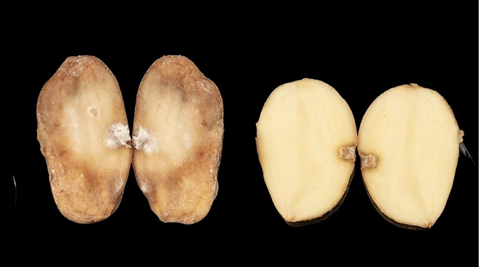
The UK’s first precision-bred potato has been approved by Defra.
The disease-resistant Maris Piper, named PiperPlus, was developed by the Jonathan Jones Group at The Sainsbury Laboratory and has received marketing notice approval under the UK's Precision Breeding regulatory framework.
The variety has the biological capacity to resist late blight, the disease responsible for the Irish Potato Famine, and to resist Potato Virus Y (PVY) and Potato Leafroll Virus (PLRV), three of the most damaging diseases affecting potato production today.
The approval follows a rigorous scientific assessment by the Advisory Committee on Releases to the Environment (ACRE). Under the Precision Breeding Act, Defra confirmed that the two new lines of PiperPlus meet the legal definition of a Precision-Bred Organism.
Under the legislation, a crop only qualifies as precision-bred if its genetic changes could have occurred naturally or through conventional breeding.
To develop PiperPlus, researchers at the Sainsbury Laboratory strengthened Maris Pipers’ natural immune system by introducing resistance genes from the potato’s wild relatives. These genes encode for immune receptors that detect pathogen molecules and activate defence.
The introduction of the PiperPlus variety is hoped to reduce dependency on chemical fungicides, which farmers spray as many as 15 times a year, according to the laboratory.
Reducing spraying could significantly lower production costs, reduce labour requirements, cut tractor journeys and carbon emissions, lessen soil compaction, and help protect beneficial soil fungi and microbiomes.
Moreover, both PVR and PLRV are transmitted by aphids, meaning the PiperPlus resistant variety could also reduce reliance on insecticide applications to control virus spread. Resistance to both diseases is particularly significant as viral loads increase with each successive potato generation, leading to progressively more severe disease symptoms.
Virus-resistant varieties could also enable more seed potato production to take place in England, as currently most British potatoes are produced in Scotland where cooler conditions help limit virus pressure. This would also help reduce transport costs and associated carbon emissions.
Professor Jonathan Jones, group leader at The Sainsbury Laboratory, said: “I’m delighted to see that after dedicated and extensive effort from my outstanding team of scientific colleagues at The Sainsbury Laboratory, supported by grants from BBSRC, we’ve identified two potato lines that have been approved by Defra for a marketing notice under the Precision Breeding Act.
“It has also been extremely encouraging to see the EU catching up by introducing its own NGT1 regulatory framework. We believe PiperPlus will become a flagship example of what’s possible through precision breeding, showing how these technologies can reduce fungicide use, improve sustainability, and deliver real benefits to the public,” he added.
The laboratory said the next step towards bringing the technology to market is by obtaining regulatory approval from the Food Standards Agency (FSA). The FSA will review compositional and safety data demonstrating that the precision-bred potatoes are as safe to eat as the conventional Maris Pipers currently available to customers.
Bringing a new potato variety to market typically takes at least five years, according to Professor Jones, due to the time required for variety registration and approval for the National List of potato varieties and for the production of sufficient quantities of seed potatoes.