Hyojun Kim breaks down the retailer’s sales structure noting recent changes that could see a bump in price after ten years
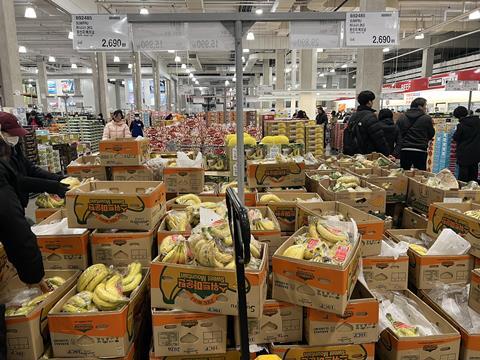
A few days ago, during a visit to Costco, I noticed an interesting scene. A sign at the entrance read: “Enjoy Free Bananas – Get one bunch of bananas when you sign up for auto-renewal.”
It got me thinking about the sales structure for Costco’s banana offering. For nearly a decade, Costco Korea has sold the same Fresh Del Monte banana format at almost the same price and even at times reducing in cost.
From 2016 to 2022 Costco Korea’s bananas cost Won2,990 (US$2.02) per bunch. This went up to Won 3,190 (US$2.16) in 2023 but dropped again in 2024 to the mid Won2,000s. From 2025 the price has settled at Won2,690 (US$1.82).
This is extraordinary.
Over the last decade, all costs involved in producing, packing, transporting and marketing have increased, but the Costco Korea SKU and retail price have remained the same. Even if we only consider labour, we see that Korea’s minimum wage rose from Won6,030 (US$4.08) in 2016 to Won10,030 (US$6.79) in 2025 – a rise of 66 per cent. And yet the price of bananas has never moved.
Unfortunately, Costco’s price has become a “polestar” for the entire retail market – a reference point every buyer uses, consciously or not.
For years, retailers sold bananas under their own structure – Won3,000 ($US2.03) or higher per bunch, Won2,000($US1.35) for markdowns. But as economic slowdown continued, the goal quietly shifted. Now, this thinking says, “A banana bunch must not exceed Won3,000.” And for psychological pricing, the first digit must start with ‘2.’ To hit this artificially low benchmark, almost all importers have had to downsize their bunch.
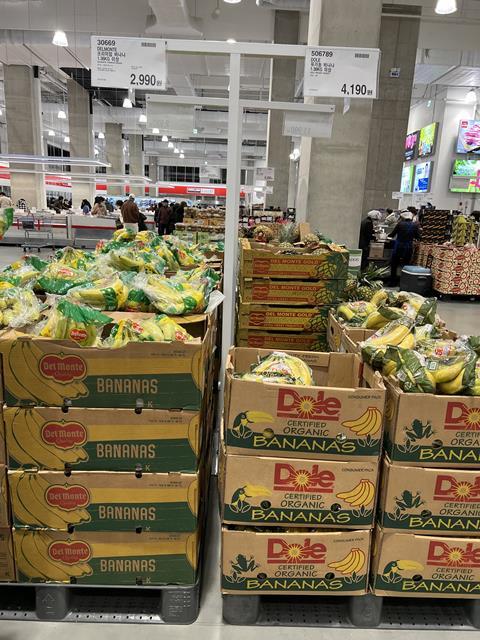
This structure impacts Fresh Del Monte more than anyone. Every retailer except Costco asks Fresh Del Monte reps, “Why can’t we match Costco’s price?” – despite not handling Costco-level volume. Fresh Del Monte has strong brand equity but the narrowest pricing freedom due to this single, rigid anchor.
Meanwhile, Dole has avoided the anchor entirely. At another Korean retailer, Traders, Dole Sweetio is positioned as a premium highland banana, priced at normal promo levels or slightly higher. Consumers don’t complain about Dole’s pricing because direct “regular banana” competition with Costco is handled by a local supplier, not Dole. This frees Dole to operate outside the Won2,990 barrier and build its own premium lane. Fresh Del Monte, meanwhile, has often supplied its premium brands such as Highland Honey or Honeyglow to Costco as regular bananas – losing the opportunity to build a true premium tier.
For more than ten years, Korea’s banana category was locked to a Won2,990 anchor, making premiumisation extremely difficult. The period when Fresh Del Monte’s wholesale and retail portfolio weakened overlaps with the period when the brand couldn’t respond strategically to this fixed anchor. It’s not simply about sales execution. It’s what happens when a brand is trapped inside a rigid pricing framework.
One might think that at least Fresh Del Monte has benefitted from unencumbered access to Costco’s large consumer base but the shelf that had been held by a single brand for more than a decade has begun to show signs of change. Dole and Sumifru have entered Costco Korea’s banana display alongside the incumbent supplier Fresh Del Monte. The three brands are now allocated across different store locations, and while origins differ slightly, retail prices and bunch sizes remain broadly the same. For Fresh Del Monte – a brand whose strategic room had been steadily narrowed by the very structure it helped sustain – the result is a visible loss of shelf dominance it once held unchallenged.
Now, a new set of pressures is building from outside the market. The ripple effects of the war between the US, Israel and Iran are reaching the global economy. International oil prices have surged to levels that threaten a key psychological threshold, and the Korean Won has approached its weakest point in years against the US Dollar. Add to this a 2.9 per cent increase in Korea’s minimum wage from the start of the year, rising operational costs across the supply chain, and the broader uncertainties that an escalating conflict can bring. In a market where the retail price of a banana bunch has barely moved in over a decade, the question is no longer theoretical: can this frozen structure hold?
If the last decade was defined by a frozen anchor, the next may be defined by a total redesign. Markets are shaped not by price itself but by the structure behind it. Korea still has plenty of room for transformation – for players who understand pricing, supply chains, brand strategy, and portfolio architecture together.