Leading shippers report severe disruption to fresh produce exports as air and seafreight services suspended
Major Indian fresh produce exporters say the Middle East conflict has left them “high and dry” as shipping lines suspend services while the closure of airspace cripples flight networks.
“As of now, all major and minor shipping lines have stopped services to all major Middle East ports,” said Azhar Tambuwala, director of Sahyadri Farms, a leading exporter of grapes and bananas among other products. “One line is operating for Dubai and Oman, but it gives no assurance [of delivery] as services can stop anytime.
“Containers have returned en route to destination as well as being sent back from the port to coldstores. Businesses are exploring local market avenues to absorb the product. Stocks are being held now in the hope that things get moving, but if they don’t, this could become a catastrophe.”
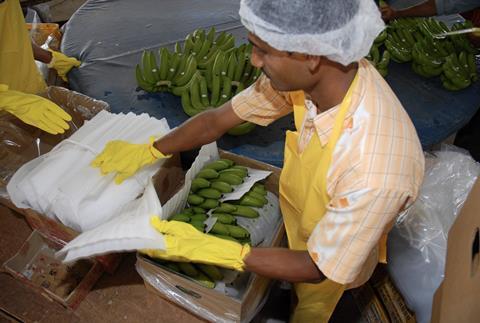
The Middle East has become a massive market for India’s banana exports, which grew by 50 per cent year-on-year in 2025 to top 1.1m tonnes, driven by shipments to Iran and Uzbekistan, according to Fresh Intelligence analysis. The region also remains a key destination for the nation’s table grape exports and a wide range of other products.
India flies several hundred tonnes of fresh fruit and vegetables to the Middle East each day, according to Kaushal Khakhar, CEO of Kaybee Exports. “With the closure of Middle East airports, those shipments will be severely affected,” he said.
Khakhar said the suspension of Middle East carriers’ services could also choke airfreight capacity on shipments to the UK and Europe.
“India also airfreights large volumes to the UK and Europe each day. These shipments used to fly predominantly on Middle East carriers. With those airlines ceasing to fly, those shipments are affected,” he explained. “However, some cargo also used to fly on direct European carriers. These carriers are continuing to fly but using a longer flight path. This requires more fuel and hence the airfreight capacity is seriously constrained.”
Khakhar said the domestic market “can easily absorb” airfreight volumes slated for the Middle East, but he warned of the potential impact on domestic market prices. “For some fruits, it may be a big impact, but for others, like pomegranates, not so much.”