US grant to support plans to double production and increase exports
The Philippine Department of Agriculture (DA) has welcomed a US$34.1mn grant from the US to develop the country’s ube industry, complementing a separate P300mn (US$4.7mn) government initiative to expand production as global demand for the purple yam grows.
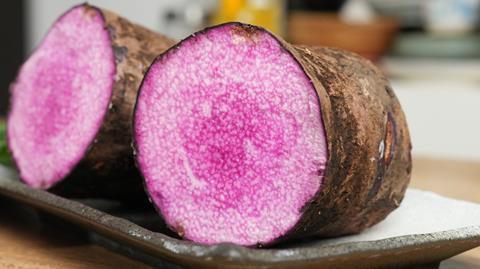
The five-year US-funded programme is expected to benefit more than 12,500 Filipino farmers and strengthen the country’s participation in international food and beverage supply chains, while the DA’s domestic expansion plan seeks to at least double output and lay the groundwork for wider cultivation.
Agriculture secretary Francisco P Tiu Laurel Jr said the US assistance would reinforce government efforts to increase production, improve farmers’ incomes and foster rural development by connecting growers to expanding overseas markets.
“We are grateful to the US government and the US Department of Agriculture for this support, which will help us scale up ube production, meet growing global demand, realize the tuber’s potential as an export winner, and create better income opportunities for our farmers,” said Tiu Laurel.
“By strengthening the entire value chain, we can turn ube into a more competitive agricultural product while fostering inclusive growth in rural communities.”
The US government, through the US Department of Agriculture’s (USDA) Food for Progress Program, awarded the grant for the development of the Philippine ube value chain.
US ambassador to the Philippines Lee Lipton announced the funding on 22 October. US-based nonprofit TechnoServe will implement the project and provide technical expertise to support industry development.
The DA had earlier earmarked P300mn for the initial expansion of ube production, targeting a doubling of the area currently planted to the crop. The first phase forms part of a broader plan to add 1,000ha in the first year.
The department is budgeting about P850,000 per hectare for farm development, support facilities, and production. The initial rollout is timed for the November 2026 harvest and propagation cycle, with ten ube varieties identified for large-scale cultivation.
Tiu Laurel said the government intends to expand the industry gradually as Philippine ube gains international attention, avoiding the supply imbalances and production problems that have affected other high-value crops following sudden surges in overseas demand.
The DA chief had earlier underscored that the government is developing the ube industry at a steady pace to limit, if not avoid, the missteps the Philippines made with previous high-value crops that drew strong overseas demand.
To this end, the government indefinitely suspended exports of fresh purple yam, or ube, in mid-August to shore up scarce planting material as the Philippines seeks to expand domestic production and turn the crop into a bigger export earner.
The suspension covers fresh ube and propagative planting materials regardless of whether shipments are intended for consumption, planting, or research.