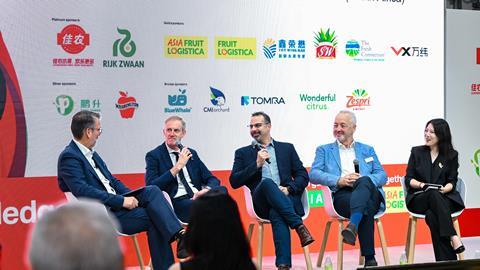
At the Asiafruit Knowledge Centre in Hong Kong, industry leaders discussed what a voluntary charter for fresh produce transportation could look like
The Global Coalition of Fresh Produce is close to developing a voluntary charter for fresh produce transportation as it looks to boost resilience and encourage ports to make fresh and perishable products a top priority.
The hot-button issue was discussed at the Asiafruit Knowledge Centre at Asia Fruit Logistica in Hong Kong this month, where the coalition hosted a special panel looking at the current challenges facing global shipping.
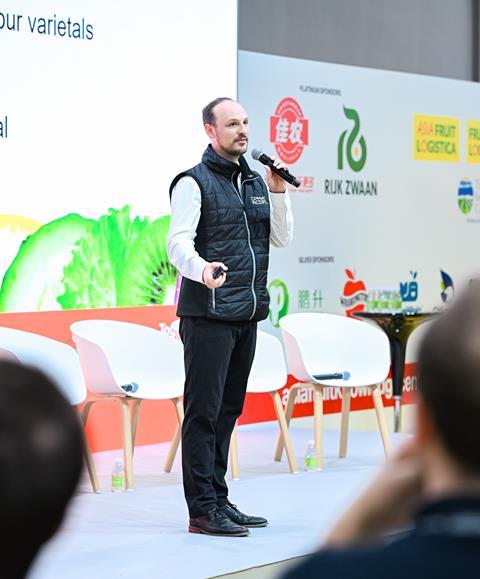
Greg Palmer, chair of the coalition and vice president of trade and market development at the Canadian Produce Marketing Association (CPMA), began by outlining the coalition’s work in bringing together different interest groups to discuss some of the major issues affecting marine transport in particular. “When we look at shipping or trucking delays, there’s not always a common language when we’re talking about the transportation of fresh produce,” Palmer said.
“There may be different terms, and different taxes. There’s a lot of breakdown of communication, so we’re inviting all stakeholders of fresh produce transportation to come together and have these conversations a bit more robustly, so we can figure out the best path forward.”
The development comes at a tense time for exporters. A survey of 89 respondents from across the supply chain on six continents found that shipping, fuel and fertiliser was the largest cost and driver of business expenditure over the past year.
Some 66 per cent of enterprises currently believe their business is at risk, a development that is even more concerning in the context of further expected shipping cost rises due to issues in the Middle East and the Suez Canal.
During his presentation Palmer outlined widespread industry concern over the reliability of getting product to the final receiver. “We’re obviously always striving for safe and high-quality arrivals to try to make sure that everyone gets the highest-possible returns,” he explained.
“And one of the biggest challenges that we continue to see is reliability on shipping partners. Lack of product on shelf has had a massive impact all the way down to the end consumer. And as soon as we start to lose some of that public trust, we know that people may start to buy other things, whether it be highly processed goods, or making a decision to start buying frozen or substitute other non-fresh fruit and vegetables.”
To combat that, the coalition wants to see ports prioritising fresh products, and that includes the development of a voluntary charter with best practice for moving fruit and vegetables. That becomes even more important against the backdrop of international trade deals that are happening at breakneck speeds, as well as the impact of duties, tariffs and cybercrime. “It is changing the way that we are going to trade fresh fruits and vegetables,” he explained.
Palmer noted that in Asia, the coalition has observed a desire for high-frequency movement, meaning that rather than waiting for an entire container ship to fill up, customers are looking to get their orders more regularly throughout the week. “It’s just the way our world is moving – it’s driving people to fresher product, and it’s driving some change in the way that we historically have done business,” Palmer said.
“This is driving smaller vessels, and quicker turns on the products that they have in warehouses without having to warehouse them for nearly as long.”
Developing a new charter
Palmer’s introduction was followed by a panel discussion chaired by CPMA president Ron Lemaire and featuring Robert Mant from Kuehne and Nagel, Ling Ma from Goodfarmer Group in China, Marc Evrard of Belgian Fruit Valley and Werner van Rooyen from South Africa’s Fresh Produce Exporters’ Forum. The discussion centred around the concept of a voluntary charter, and what that should look like, with the panellists stressing the importance of protecting the integrity of the cargo and the quality of the fresh produce.
The development comes in the light of companies already taking additional steps to ensure their produce reaches them on time and in the right condition. Ma revealed that from the perspective of Goodfarmer – which imports a staggering 600 containers of bananas every week – futureproofing the system means taking a proactive approach. “Proactive risk-management frameworks, especially for us as an importer, must be put in place instead of reacting passively to problems,” she said.
“Currently, logistics and supply chain reliability has become our top-tier criteria in purchasing decisions, and we have incorporated evaluation of our shipping service providers for their temperature-control capability, on-time performance, container rollover records and so on. So we will analyse their performance in advance to choose which shipping lines or service we will use for our products.”
As Mant emphasised, while logistics 10 years ago was “an inconvenient truth”, it has now become a central topic with customers such as supermarkets questioning the sourcing because of the reliability of logistics. “Clearly there’s a paradigm shift in this, and I think we should all take that on board now,” he added.
When it comes to the development of a voluntary charter and what that could involve, Evrard noted that in some companies and government institutions in Belgium, the workforce gets a bonus if products arrive on time. “Perhaps the pricing system should be used differently with shipping lines, so they have a basic rate, and then if they actually do what they are supposed to be doing, they might get a premium,” he suggested. “A bonus if they do a good job.”
Van Rooyen said best shipping practices can serve as a guideline to show some fairness and transparency in dealings between logistics players in the chain. “I think it’s critically important that you have some sort of index and benchmark to work from to try to solve the problem for the future, and future-proof yourself in a sustainable way,” he added.
Transparency and accountability

Lemaire highlighted successful transparency programmes outside of the logistics sphere, such as the UK’s Groceries Supply Code of Practice and the Canada Grocery Code – essentially “name-and-shame” frameworks to keep powerful players accountable for buyer-seller relationships – and questioned whether such a scheme could work in shipping.
Evrard added that while that would be feasible, an additional problem has been the abundance of consolidation in the shipping industry, which has left the sector in a constant state of flux. “Is it a bad evolution? Not necessarily, but it requires additional responsibility of the bigger consolidated groups,” he said.
Mant stressed that benchmarking is already happening within individual companies, but the bigger issue is having public-facing, standard data for the whole industry to share.
For a new charter, Ma said it’s important to draw a clear line between genuine force majeure and delays that shipping lines can control, and to work out clear rules to assign responsibility for damage to fresh cargo. Mant agreed, stressing there also needs to be open and transparent dialogue on the real reasons for delays. “Moving forward, let’s have more open conversations instead of hiding the truth,” he said.
Much of it comes down to taking responsibility, as Evrard pointed out: “As long as every participant in the supply chain – whether it’s a grower, exporter, importer, distributor, retailer, forwarder or shipping line – takes responsibility and is committed, a lot of the issues we are currently facing would not be there. All of us should be upheld to the same standards, and we are not asking for the impossible.”
Summing up, Lemaire stressed the concept of a charter is not “an us-against-them conversation”, stressing that it’s a question of an integrated framework that brings everyone moving forward together to bring reliability, accountability and cost savings.
The coalition has been working intensively on the concept with its members since early 2026, and a draft document is available to view here, along with a summary.