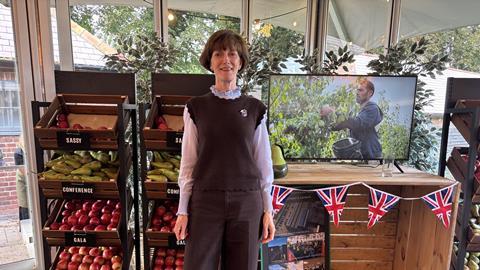
Trade body urges retailers to reduce audit burden on growers and reports strong engagement with sustainability reporting project
British Apples and Pears Limited (BAPL) has called on the British Retail Consortium to convene the UK’s leading grocery chains and create an action plan to reduce audit duplication and cost.
Speaking at BAPL’s British Apple Harvest Event on 16 September, executive chair Ali Capper stressed that audit duplication is one of the main barriers to investment and expansion for UK topfruit growers.
“We absolutely support robust assurance on food safety and high standards,” she said. “But where growers are already independently audited against recognised standards, we believe there is an opportunity to reduce duplication and unnecessary cost.
“We found a 91 per cent overlap between one retailer audit and existing assurance requirements and an 88 per cent overlap with another.
“Every audit standard duplication we remove is time and money that can instead be invested in producing even better quality British topfruit.”
Sustainability reporting
Although still in development, Capper highlighted BAPL’s Carbon, Water and Nature project – to help growers track the impact of their sustainability measures – as “one of the most encouraging pieces of work” the trade body has undertaken this year, thanking growers and retailers for their engagement so far.
The project is nearing the end of its scoping phase and will be delivered next year.
“What has been particularly encouraging is how much common ground exists across the sector,” she said. “Different businesses use different systems and have different priorities, but the conversations keep returning to the same themes: understanding carbon, managing water responsibly, protecting biodiversity, improving soil health, and building resilience through regenerative practices for the future.
“Our ambition isn’t to create another reporting requirement. Quite the opposite. We want to help develop a trusted approach where retailers can rely on BAPL for the reporting. An approach that reduces duplication, provides meaningful information and works for both growers and retailers.”
Sector Growth Plan
Reducing audit burden is just one area that BAPL is focusing on in its work with Defra to help develop the eagerly anticipated Horticulture Sector Growth Plan. Capper also highlighted access to labour, exports, R&D, tax reliefs, and health/nutrition messaging.
All these areas will be important for helping the sector continue its push to increase market share for British apples at UK retailers from 40 per cent to 60 per cent by 2035, Capper said.
As the UK negotiates a new SPS agreement with the EU, she called on the government to support UK topfruit growers to compete with their EU counterparts by giving them access to: adequate crop protection, affordable seasonal labour, water, agile planning regulation that enables expansion, affordable energy, funding for a new research and innovation function for UK horticulture, improved investment tax reliefs, and improved public nutrition messaging.
Health claims
BAPL is also pushing for a change of legislation to make it possible for apples and pears to print the fruit’s health benefits on pack. Encouragingly, she reported “very constructive discussions with colleagues at the Department of Health and Social Care and Defra about how we better communicate the health benefits of fresh fruit and vegetables”.
Capper added: “British apples and pears have an exceptional nutritional story to tell, yet current regulations make it far easier to communicate the health credentials of many UPFs than fresh produce.
“Our ultimate goal is to see the health credentials of apples and pears printed on the packaging and on in-store POS.”
Capper’s ‘incredible input’
The British Apple Harvest Event – this year hosted by Mansfields – once again brought together almost all the UK’s major retailers and topfruit growers, highlighting Capper’s success in uniting the industry behind a common goal of backing British producers.
“Days like today remind us that the British apple and pear industry succeeds because it is built on partnerships,” she said. “No single part of the supply chain delivers success on its own. Our role isn’t simply to represent growers; it’s to bring the whole industry together around the opportunities and challenges we all share.”
The event was Capper’s last major public engagement as executive chair of BAPL before she leaves to chair British Berry Growers instead.
BAPL’s vice-chair James Simpson, who is the managing director of Adrian Scripps, praised Capper’s wide skill set and experience and thanked her for her huge contribution to the sector over the past eight years.
“We started to engage with government; we started to engage more with retailers; we started to engage more with growers,” he said. “I don’t think the industry would be where it is now without Ali’s incredible input.”
New leadership
Looking ahead, Capper welcomed incoming BAPL chair Claire Donovan, who will head up the trade body alongside her role as CEO of the Modern Slavery Intelligence Network (MSIN).
Donovan is working alongside Capper during a two-month handover in September and October, before formally taking the reins at BAPL on 4 November.
Donovan told FPJ her aim was to “build on the amazing work that Ali has done in bringing the British apple and pear sector together and making it a formidable industry to deal with”, stressing that as the UK enters a new phase in its relationship with Europe, “we need to make sure British growers get a really safe footing”.
Commenting on how her work at MSIN will inform her new role at BAPL, she added: “What I’ve found really works is giving growers the tools they need to get the best out of seasonal workers and spot the signs of any abuses.
“In cases where exploitation does occur, we know that a lot of the scamming is done before workers even get to a recruitment event, so helping workers understand their rights and giving them the opportunity to speak is really important.”