
€9.2mn marketing push emphasises freshness of mangoes imported from Spain’s Tropical Coast, targeting consumption growth in strategic European markets
Spain is embarking on a new mango marketing campaign – in the UK, France, Italy and Spain – with avocado and mango trade body Intertropic focusing on the fruit’s health benefits, freshness, and flavour.
The aim of the €9.2 million campaign – which runs for three years and is co-funded by the EU – is to boost per-capita mango consumption in these key markets and educate consumers about the versatility, seasonality, longer tree ripening, and lower carbon footprint of mangoes transported by road from Spain’s southern coast.
Speaking to FPJ at a promotional lunch in London, Intertropic’s CEO Antonio Carpintero emphasised Spain’s proximity to the UK and other European markets as an important advantage in terms of the fruit’s freshness and flavour when it reaches consumers – compared with mangoes shipped long distances while still green.
He also made the point that although the EU’s strict phytosanitary standards can be restrictive for growers, they should be viewed as an opportunity to demonstrate the responsible practices behind European fruit.
Carpintero accepted that mangoes’ country of origin is not always front of mind for consumers, but hopes the campaign will go some way to changing that.
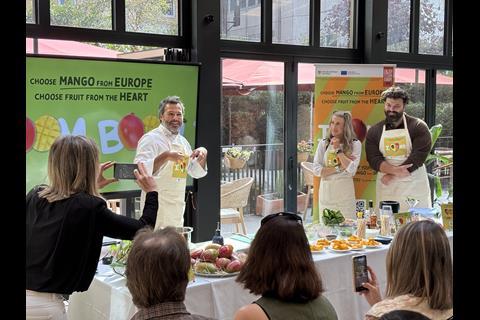
The event near Liverpool Street on 24 September – with Spain’s short August-November season in full flow – demonstrated the versatility of mangoes through a range of dishes.
Spanish-Indian celebrity chef Omar Allibhoy prepared chicken and mango curry, sea bream and mango ceviche, mango jelly, and a range of canapés and cocktails for influencers and content creators to sample.
Market opportunities
According to Intertropic, average mango consumption in Europe sits at roughly 1kg per person per year, leaving significant headroom for growth.
The UK has been targeted as a relatively mature European market for mango, with a booming convenience sector and significant growth in wholehead fruit through the major multiples in recent years. In particular, ethnic populations have helped to support demand.
France, meanwhile, is the biggest importer of Spanish mangoes, accounting for roughly 40 per cent. And according to Carpintero, Italy has ‘incredible potential’ from a lower base due to shoppers’ focus on health and flavour.
Spain’s mango campaign includes TV adverts, collaborations with content creators, and tastings in supermarkets and gyms, as Spanish mango producers try to connect with foodies and health-conscious shoppers by positioning mangoes as a gastronomic superfood.
The concept behind the campaign is of a ‘contract’ or ‘deal’ with yourself. ‘You take care of yourself by picking a perfectly ripe mango from Spain,’ read the marketing materials, and ‘it takes care of you by giving you energy and vitality’.
Meanwhile, a ‘boom, boom’ tagline references a heartbeat since, according to the campaign, Spain’s mangoes (like its avocados) are a ‘fruit from the heart’.
Quality first
In terms of production, Spain grows around 6,150ha (52,500 tonnes) of mango in Malaga’s Axarquía region and Granada’s Tropical Coast thanks to the areas’ tropical microclimate. Growers such as Trops, Reyes Gutierrez, Montosa and Frutas Los Cursos account for a large chunk of the production.
Protected by the Sierra Nevada mountains and warmed by African winds, these coastal areas benefit from stable subtropical temperatures and frost-free winters, which mangoes need to thrive.
The main challenges for Spain’s mango growers, according to Carpintero, are ensuring that growers harvest fruit at the right moment during the short season (without compromising quality, repeat purchase or price), labour shortages, and competition with other (year-round) sources such as Brazil.
When it comes to coordinating well-timed picking, Intertropic has recommended that growers only harvest their fruit when it reaches minimum Brix and dry matter requirements – namely seven degrees Brix and 15 per cent dry matter (for most varieties).
The interprofessional organisation is working to make these picking requirements mandatory – by spot checks – for all Spanish mangoes supplied to the fresh market.