Rebounding production in China drives significant growth in pear, apple and citrus imports
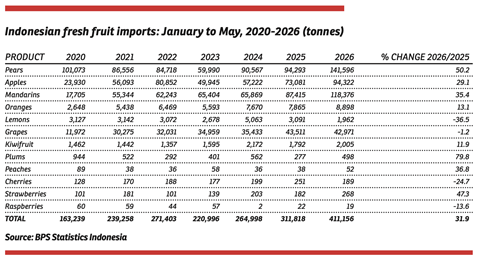
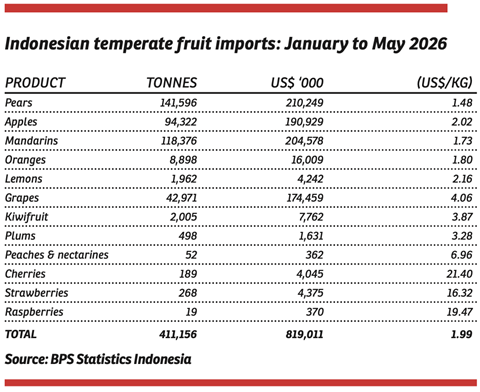
Indonesia’s fruit import sector recorded exceptional growth in the first five months of 2026, with volumes rising 31.9 per cent year on year to 411,156 tonnes. Import value also climbed sharply, reaching US$819mn, up from US$644.5mn in the same period of 2025. Indonesia’s fruit import boom highlights the country’s growing consumer base and rising demand for affordable fresh produce. Low-cost fruits are driving volume growth, but premium categories (including grapes, stonefruit and berries) continue to offer opportunities for suppliers able to differentiate on quality and presentation.
Pears, mandarins, apples and grapes accounted for 96.7 per cent of total import volume and 95.3 per cent of value in early 2026. Pears (up 50.2 per cent), mandarins (up 35.4 per) and apples (up 29.1 per cent) were the main fruits driving this strong growth in Indonesian fruit imports. These three fruits are among the lowest-cost imported fruits, with pears at US$1.48 per kg CIF (cost, insurance and freight), mandarins at US$1.73 per kg CIF and apples at US$2.02 per kg CIF.
China has strengthened its position as Indonesia’s overwhelmingly dominant fruit supplier, expanding its market share to 85.6 per cent across all major imported fruit categories – pears (97 per cent), apples (92.5 per cent), mandarins (91.2 per cent), lemons (83.5 per cent), oranges (68.5 per cent) and grapes (27.4 per cent). China’s grip of Indonesia’s fruit market is stronger than ever. Its ability to supply large volumes at low prices suits an expanding and price-sensitive consumer market.
Apple and pear boom
Pears posted a remarkable 50.2 per cent increase in import volume, reaching 141,596 tonnes, up sharply from 94,293 tonnes in the same period last year, cementing its position as Indonesia’s fastest growing imported fruit category. At just US$1.48 per kg CIF, pears are the cheapest major imported fruit, making them highly attractive to Indonesian consumers. China supplied 97 per cent of Indonesia’s pear imports, underscoring its total dominance of the category. South Africa continues to be the main Southern Hemisphere supplier of pears (Packham), supplying almost 4,000 tonnes in early 2026. Australia’s shipments fell significantly, dropping to 61 tonnes.
Apple imports also posted strong growth (29.1 per cent), rising to 94,322 tonnes between January and May 2026, up from 73,081 tonnes in the corresponding period of 2025. China strengthened its dominant position, shipping 87,249 tonnes, a substantial increase from 64,204 tonnes last year. The US remained the second-largest supplier but saw volumes ease to 5,819 tonnes, down from 6,545 tonnes. The major Southern Hemisphere supplier, New Zealand, saw shipments fall to 972 tonnes, compared with 1,764 tonnes in 2025, while South Africa recorded a notable decline, supplying 260 tonnes versus 448 tonnes a year earlier.
Grape category matures
Australia remained Indonesia’s leading grape supplier in early 2026 with 27,000 tonnes, commanding 62.8 per cent of the market. Australian grapes continue to enjoy strong recognition for quality, flavour and food safety; these are attributes that resonate with Indonesia’s growing middle class. Consumers are also becoming more familiar with colours and premium varieties rather than simply buying “grapes”. Large berry size, sweetness, crunch and attractive packaging are increasingly important marketing points to attract consumers. China’s share of the grape category has climbed to 27.4 per cent, reflecting rapid improvements in Chinese grape quality and increasingly competitive pricing.
Almost 4,000 tonnes of grapes were supplied by the other main Southern Hemisphere suppliers (Peru, Chile and South Africa).
Mandarins dominate citrus
Indonesia’s mandarin imports continued on a strong upward trajectory in early 2026, rising 35.4 per cent to 118,376 tonnes between January and May, up from 87,415 tonnes in the same period last year. China remained the dominant supplier, shipping 107,990 tonnes, a substantial increase from 77,458 tonnes in 2025. Pakistan also grew its presence, supplying 10,337 tonnes, up from 9,783 tonnes a year earlier.
Orange imports reached 8,898 tonnes to start 2026, up from 7,865 tonnes in the corresponding period last year. China strengthened its position with 6,095 tonnes, a notable rise from 4,313 tonnes in 2025. Egypt supplied 2,362 tonnes, down from 2,778 tonnes, while US shipments fell to 418 tonnes, compared with 753 tonnes a year earlier.
Lemon imports declined sharply in early 2026, totalling 1,962 tonnes, down from 3,091 tonnes in the same period last year. China remained the leading supplier but saw volumes almost halve to 1,639 tonnes. Australia quadrupled its shipments to 194 tonnes and Egypt re-entered the market with 75 tonnes.
Mixed bag for smaller categories
Kiwifruit imports reached 2,005 tonnes between January and May 2026, up from 1,792 tonnes in the corresponding period last year. New Zealand remained the leading supplier with 935 tonnes, on a par with the year prior. China continued its rapid expansion in the category, shipping 805 tonnes, up from 526 tonnes a year earlier. Greece supplied 167 tonnes, slightly below the 182 tonnes shipped in 2025.
Indonesia’s plum imports rose strongly in the January-May 2026 period, reaching 498 tonnes, up from 277 tonnes a year earlier. Australia remained the leading supplier, shipping 398 tonnes, an increase from 237 tonnes in 2025. South Africa also expanded its presence in the category, supplying 97 tonnes, up from 39 tonnes last year.
Imports of peaches and nectarines totalled 52 tonnes in the first five months of 2026, up from 38 tonnes in the same period of 2025, while cherry imports declined to 189 tonnes from 251 tonnes. Australia was the top supplier across all three categories.
Indonesia’s strawberry imports increased strongly, reaching 268 tonnes, up from 182 tonnes a year earlier. Korea continued to dominate the category, supplying 245 tonnes, up from 166 tonnes in 2025.