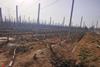
Enforcement of earlier judgement results in court-supervised destruction of illegally planted trees in the Gansu province
T&G Global (T&G) has reported another significant legal victory in the Supreme People’s Court of the People’s Republic of China, again successfully defending the plant variety rights of its premium Scilate apple variety.

In late December 2025, the Supreme People’s Court issued a final judgment in favour of T&G in a dispute with a Chinese defendant regarding their infringement of T&G’s plant variety rights. This judgment upholds the earlier ruling by the Qingdao Intermediate People’s Court in April 2025.
T&G chief executive, Gareth Edgecombe, said the case was a significant win for T&G in its continued efforts to protect its intellectual property.
“We welcome this ruling by the Supreme People’s Court and the commitment it shows under China’s strengthened Seed Law to safeguard plant variety rights and put a stop to illegitimate production and infringement,” he said. “With it being the second ruling in T&G’s favour, by China’s highest court, it establishes a strong judicial precedent for the handling of similar infringement disputes in China.”
Edgecombe added that over the last 20 years, T&G had invested in research, development, sales and marketing to develop the Scilate apple variety, which is sold under the premium Envy apple brand.
“Today, Envy is the third leading apple brand in China, and we are focused on growing the brand in this important market, supported by legitimate, locally-grown licensed Envy apples from our authorised local grower, Joy Wing Mau,” he said.
“The Court’s judgement, as well as the recent Regulations on the Protection of New Plant Varieties, which give the authorities strong powers to investigate and enforce infringement of plant intellectual property rights, will benefit plant breeders, growers, customers and the horticulture sector, and provide T&G with further confidence to continue investing in China knowing our intellectual property is well protected.”
The infringement occurred in the Shandong Province, China’s main apple growing and production region, and involved the unauthorised production and propagation of Scilate variety materials, and the online and offline sale of harvested fruit from the illegally propagated materials. The infringing products were promoted and sold using marks similar to T&G’s Envy, with the defendant attempting to take advantage of Scilate’s strong reputation and brand.
Given the scale and prolonged duration of the infringement, the Court has ordered the defendant to pay significant damages to T&G and to stop all infringement of T&G’s Scilate plant variety rights.
Following on from the first favourable judgement by the Supreme People’s Court of the People’s Republic of China in early 2025, enforcement steps have now been taken, resulting in the Court-supervised destruction of a large number of illegally planted trees in the Gansu province.
“With T&G and our Chinese legal team having built up considerable experience in collecting, tracing and analysing sources of infringement and preparing litigation cases, we are well set up to continue to pursue enforcement of our intellectual property rights,” Edgecombe said. “This is supported by the work the Supreme People’s Court has done to establish a repeatable and credible process of plant variety rights protection and the introduction of the Seed Law and associated regulations. This foundation will help protect legitimate Chinese breeders and growers and grow the profile of China’s horticulture sector as an attractive region for protectable new variety development and commercialisation.”