Industry conference looks at potential of scaling pulse production to meet demand
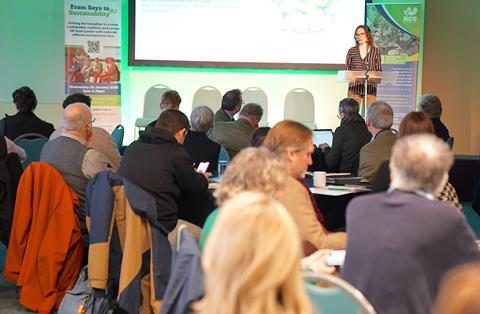
The scale of the opportunity for UK peas and beans to significantly reduce reliance on imported soya and deliver substantial environmental gains was laid bare at a dedicated event last week.
The cross-industry From Soya to Sustainability conference in Peterborough heard how a combination of science, applied research, farmer-led trials and growing supply chain engagement is creating the conditions for a major shift towards domestic pulse production.
A diverse audience saw how significant progress has been made in key areas of the supply chain where, previously, doubts had been cast on whether unsustainable proteins – such as uncertified South American soya – could ever be replaced.
Integrating beans into livestock and poultry rations on a commercial scale, and the financial modelling to demonstrate how UK arable cropping could flex to meet greater demand for pulse protein, were among the studies unveiled at the event.
Balancing expectations with commercial realities
Keynote speakers Nicola Brennan and Professor Neil Ward set out the impact that the livestock feed industry’s reliance on soya is having on UK agriculture’s carbon footprint, and what needs to change.
Brennan, a supply chain specialist with WWF-UK, linked the issue to national resilience and security, referencing recent government assessments.
“Accelerating nature loss is not just an environmental issue. It is a foundational threat to global stability and UK security,” she said. “The UK has a major role to play in setting global trends, with a disproportionate footprint per tonnes of product consumed. It is critical that the private sector starts supporting farmers to produce food with positive environmental impacts both abroad and in the UK.”
Ward, who specialises in rural and regional development at the University of East Anglia, highlighted the growing links between climate change, food systems and economic stability.
“Climate change is already affecting supply chains and driving food price inflation. Adaptation is non-negotiable,” he said. “We need to think about food resilience and security in a way we haven’t for decades.”
Window of opportunity
Data from The Andersons Centre shows that about 1.6 million tonnes of beans would be needed to replace half of the soya currently used in UK livestock feed.
To grasp this opportunity, yields need to increase and the consistency of crops improve at the same time. The NCS Project has appointed 30 Pulse Pioneers who are paid to conduct a variety of on-farm trials in their areas of interest and share results among their peers. With improvements, the economics of growing a pulse crop would change dramatically.
“But we won’t get there unless value generated further down the chain is shared back with arable growers,” said The Andersons Centre’s James Webster-Rusk, who led the research on behalf of the project.
Monogastric expert Professor Jos Houdijk from SRUC outlined feeding trials he had conducted at Scotland’s rural college which found that post-harvest processing of beans can overcome previous limitations associated with higher bean inclusion in poultry rations.
“When we feed more beans to poultry, we get a dent in production efficiency because the animal can’t digest it,” he said. ”But when we de-hull or de-hull and toast beans, that dent is taken away. The animal performs as if that detriment was never there.
“This work tells us that, both in broilers and in laying hens, processing beans helps us increase the soya replacement potential of faba beans.”