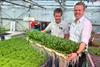
Salad producer is blending decades of growing expertise with cutting-edge indoor systems to drive resilient, high-quality production all year round

Jepco's Richard Pett with Zayndu's Nathanael Dannenberg

Jepco’s Richard Pett with Zayndu’s Nathanael Dannenberg

Image: Zayndu

The loss of tools to combat pests, weeds and diseases in the salad sector, combined with changes in market dynamics, has encouraged Lincolnshire-based leafy salad producer Jepco to increase its glasshouse production capacity.

The third-generation producer, which grows 800ha of outdoor leafy salads, sees controlled environments as providing an opportunity to adopt new technologies to boost output while improving produce quality and consistency.

As part of that programme, Jepco has been preparing production strategies with an in-house development team and research facility.

“Our goal with indoor production is to be carbon neutral, produce 52 weeks of the year and mitigate a lot of the risks we take outdoors with climate change,” says Richard Pett, development manager at Jepco. “Producers are getting more and more extremes, with dry times, wet times, or hail. Since the middle of August, the sector have also had difficulty controlling aphids in the field.

“We’re just not getting the tools to control field pests anymore. Weed control is another example where fewer herbicides are available to us. We have been using camera-guided and GPS hoes for 20-plus years, and we’re looking at robotic and laser weeders. There aren’t those options with pest control.”

Benefits of greenhouses

Moving some production into greenhouses will allow Jepco to remove aphids, other insect pests and foreign contaminants from their growing equation, Pett explains. They have also seen that indoor production gives them much more control over the quality needed for specific catering markets, such as sandwich production.

“Soil from outdoor lettuce is a huge problem,” he adds. ”If we get heavy rain just before harvest, soil splashes onto the leaves. It must then be washed vigorously before being sent to customers, which affects its shelf life. Since moving our lettuce production destined for sandwiches indoors, we have almost eliminated non-conformities.”

The obvious challenge to increasing indoor production is the capital investment required to build the facility. That is why Pett has been examining the latest glasshouse technology to maximise output. “There is so much technology and innovation out there at the moment. It’s about identifying it and seeing how it can help us,” he says.

Plasma seed priming

Zayndu's on-site seed-priming system

Zayndu’s on-site seed-priming system

Image: Zayndu

One innovation Jepco has been trialling is Zayndu’s ActivatedAir plasma seed priming. Based in Loughborough, Zayndu sells its on-site seed-priming system globally to vertical farms and glasshouses.

Nathanael Dannenberg, UK and North America business development manager for Zayndu, introduced Pett to ActivatedAir, having previously collaborated on other technologies. “We deploy machines into growers’ facilities that are capable of priming seeds using Zayndu’s cold plasma technology,” Dannenberg says. “The process is pesticide and residue-free, and being based on-site, it gives growers control over when they prime seeds.

“The priming creates microfissures in the seed surface, which increases water absorption. It also kick-starts the seed’s biochemical pathways, stimulating germination. This makes seeds germinate quicker and more evenly.”

In short-cycle crops, the impact on output can be astonishing, according to Dannenberg. In Jepco’s case, a yield increase would manifest as a shorter time to harvest. This would increase output from the same capital investment in the glasshouse, as Pett explains: “A key driver for working with Zayndu is that if we reduce the number of days to harvest by three days per cycle, then we can get another crop cycle in per year.”

The trials on ActivatedAir were conducted in Jepco’s dedicated research greenhouse. Smaller than a commercial greenhouse, Pett says that they can accurately replicate a production situation. In this case, he observed an average 11 per cent increase in spinach yields and 13 per cent in rocket across multiple replicates over a nine-month period.

“There does seem to be a definite difference, and we have done quite a few trials now across rocket and spinach. The results are reliable; we are seeing a difference every time, which is exciting.”

Pett sees all the technologies the firm are testing as building a cumulative effect, which supports the justification for a significant capital outlay to build more glasshouse capacity.

“You take 11-13 per cent from priming the seed, perhaps another three per cent from adding a biome to the water in the hydroponic system, plus other measures, and it all adds up. We most definitely see a role for technologies like Zayndu’s seed priming,” he concludes.