Italian supplier to launch branded line for premium snack market in June, with commercial tests in Italian and German retail stores
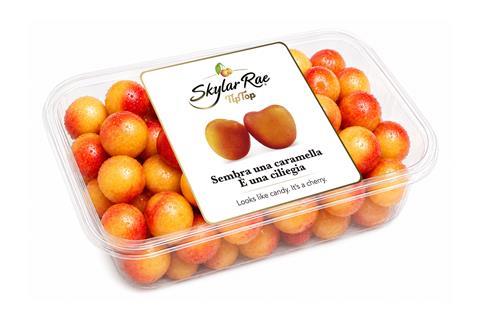
Italian supplier Rivoira Group is ready to launch a branded line of stemless cherries which it says can attract new sales in the premium snack market alongside fresh berries.
Marketed as Skylar Rae and dubbed the ‘CherryBerry’, the product presents an existing variety called Tip Top as a natural, ready-to-eat snack with its stalks already removed.
“We didn’t want to simply introduce a new variety, but to change the way consumers experience cherries,” explains the company’s CEO, Marco Rivoira.
For years, he says, the stem has been considered an essential element of the cherry, but new research into Tip Top uncovered “something surprising”, he notes.
“By gently removing the stem directly in the field, the fruit perfectly maintains its quality and even improves certain physical characteristics.”
Encouraged by that discovery, Rivoira Group is already expanding production of the variety, for which it holds the exclusive rights across Europe.
During the first phase, Skylar Rae will be marketed exclusively by Rivoira Group, focusing on leading Italian retailers, selected strategic German chains, and specific overseas market trials.
In June, the product will make its commercial debut with an initial pilot project in Italian and German retail stores.
Production expansion
The group has already planted a total of 25ha in Italy, while its partner Vidrio is developing a licensed programme in Spain covering more than 300ha.
Its aim is progressively to build a new premium category within the European cherry market.
“Today’s consumers are looking for products that are not only delicious, but also easy to consume and compatible with a dynamic lifestyle,” continues Rivoira.
“With the CherryBerry concept, we take cherries beyond their most traditional image and transform them into a premium ready-to-eat snack.”
The project also offers advantages in terms of logistics and sustainability, for example by removing the stems and therefore increasing pack capacity and transport efficiency.
With the same packaging format, in fact, an estimated 25-30 per cent more product can be included.
“It’s not about reducing the product’s value,” Rivoira points out, “but about increasing the overall efficiency and sustainability of the system.”