Rising cost pressures and oversupply are putting the industry under strain
The Malaysian durian industry is in “survival mode” trying to manage an early supply glut and a cost crunch as the season begins.
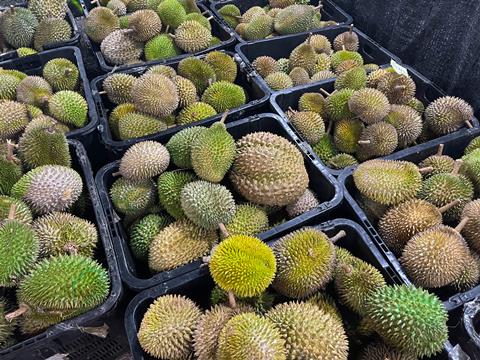
According to a report from the South China Morning Post, the current season is creating a perfect storm of challenges for growers.
Warmer temperatures have brought forward the harvest and volumes continue to grow as the industry looks to cash in on demand for durian in the country’s largest export market, China.
In addition to the supply strain, the conflict in the Middle East has driven up other costs – including fuel, packaging, energy and transport.
Stephen Chow, director of Chow Kai Pheng Enterprise, said growers had to find savings and reduce waste to stay afloat.
He said packaging and logistics had previously accounted for about 20 per cent of export revenue, but in recent weeks he had been bracing for that share to rise to as much as 50 per cent.
“We didn’t expect the war to impact us this badly. We are trying not to shift the costs to consumers,” Chow said.
“We are in survival mode, we are cutting costs and we hope the government can help with some relief to help farmers get through this period.”
At the same time, China’s durian market has become increasingly competitive. In the past, Malaysian exporters have secured a premium for the popular Musang King variety, but increasing volumes could bring the Malaysian offering back in line with other high-volume suppliers.
“We position Musang King in the premium market and we need to maintain that, so in the long term we need to develop this segment instead of competing,” Chow said.
Malaysia-based Asian durian expert Lim Chin Khee said Malaysia had built the reputation of its’ durian on quality and branding, which was reliant on an affordable and tightly managed cold chain to preserve quality.
“Exporters either have to absorb the increase or pass it down the chain, which is not always easy. Compared to Thailand, Malaysia already operates at a higher cost structure, so any increase in logistics costs tends to hit harder,” Lim said.
“If air freight becomes too expensive or less reliable, exporters may reduce shipments or shift more volume into frozen products, which generally fetch lower margins.
“So while Musang King’s premium positioning is a strength, it also makes it more sensitive to disruptions in logistics.”