Key findings will be presented to Lockyer Valler growers on 11 February
Australian onion growers battling crop loss from fungal pathogens will now have access to a world-leading DNA-based test developed by Queensland biotech company Metagen.
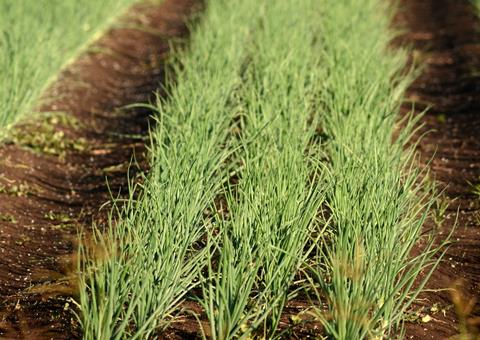
Metagen is in the final stages of its Horticulture Innovation-funded and Ausveg-supported project, “Rapid test and fungicide resistant screening for Stemphylium leaf blight (SLB) in onion” and will present its findings to Lockyer Valler growers at an event on 11 February.
The project, which began last August, was undertaken by Metagen to improve pathogen detection and diagnostic accuracy.
Led by Ben Evert in collaboration with plant pathology researcher Noel Knight, microbiologist Neil Wilson and agronomist and Metagen co-founder Shane Fitzgerald, the team successfully developed a qPCR primer at Metagen’s Gatton laboratory.
It has now been calibrated and will shortly be published for global use as onion canopy disease is now a worldwide concern. The testing service will be available for the next onion season.
Evert said the project combined molecular diagnostics with field work alongside Lockyer Vallery growers. Seventeen onion crops were sampled across two surveys including disease assessments, leaf lesion samplings and soil chemistry analysis.
Key findings confirmed Stemphylium species were the dominant fungal pathogens identified in the Lockyer Valley, followed by downy mildew (DM). Very little purple blotch (PB) was detected, he said.
“Stemphylium vesicarium was found to persist on alternative plant hosts including weeds on border blocks and headlands, well after harvest,” Evert said. “Research shows SLB progressing from a low-level infection in cooler conditions to heavy secondary infection as temperatures increase. Downy mildew infection ceases once temperatures exceeded 29 degrees. An increase in thrips population is also strongly associated with increased SLB infection.”
He added that as SLB can infect lesions initiated by DM and PB, diagnosis is difficult.
“With limited disease detection tools until now, it has been very difficult for growers to know what they have and how to treat it,” he said.
A secondary goal of the project was to investigate the sensitivity of SLB to fungicides.
“Using advanced genomics and in vitro lab assays (experiments) we were able to identify fungicide groups where efficacy is reduced and others where efficacy is retained,” Evert said. “This information will now be reviewed by the onion industry which will use this information to inform which strategies should be implemented for disease control moving forward.”
Evert also said ongoing monitoring of SLB fungicide susceptibility was an obvious next step to ensure the industry stays on top of fungicide resistance.
Fitzgerald said the project was the first of its kind for Metagen and reinforced the importance of early detection.
“The qPCR enables early detection of SLB in the canopy, even when the disease is not yet producing spores,” Fitzgerald said. “Combined with climate data, this allows timely, targeted disease management decisions. Balanced soil chemistry is also fundamental to improving disease resistance and canopy performance.”
An estimated 80 per cent of local growers have had SLB in the past 12 months, according to Fitzgerald, with impacts so devastating some have decided not to plant onions again.
“The proactive approach from our funding partners Hort Innovation and Ausveg has enabled us to shorten the timeline in identifying a solution for this industry wide challenge,” Fitzgerald said.
“We’ll now focus on the next stage of supporting growers to manage disease and build a more sustainable future,” he said.