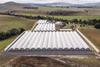
Premier of Tasmania Jeremy Rockliff officially opened the facility at a launch event attended government and industry representatives

Tasmanian strawberry propagator JCLM Farming has doubled its annual plug plant capacity to 5mn following an official launch of its Stage 4 expansion at Ouse on Thursday. 

stage-4-jclm-farming-1-hr

Stage 4 of the JCLM expansion 

Image: JCLM Farming

Premier of Tasmania Jeremy Rockliff officially opened JCLM Farming’s Stage 4 misted tip facility at an event attended by state and federal members of parliament, local government representatives, leading Australian strawberry growers, suppliers, contractors and berry industry representatives.  

Construction of the A$800,000 expansion, including 12 additional polytunnels erected over 1ha, began last November and finished ahead of schedule in mid-June. 

The high-tech strawberry propagation operation is one of two of its kind in Tasmania and among several in Australia with misted tip capability. JCLM Farming, which built its first polytunnel in 2023, now has 26 tunnels – all providing optimum growing conditions for year-round supply of strawberry plants to growers nationally.  

JCLM Farming managing director Jack Beattie, who welcomed guests and led a tour of the facility, said the expansion was in response to surging demand Australia-wide for strawberry plug plants over the past two years. 

“Our focus continues to be on generating value for our customers. There’s a strong move across the global industry away from soil plants and into plants grown in substrate – plugs, mini-trays or tray plants. The plant types we’ve distributed in recent seasons have been very well accepted by our customer base,” Beattie said.  

He travelled extensively throughout Australia and internationally to investigate industry-leading strawberry propagation facilities and replicate the best set-up for his central Tasmanian location. 

“At our specialised nursery we focus on the high-intensity propagation of strawberry tips. Once we have propagated these tips, they are grown out into established plug plants, mini-trays or tray plants. It’s quite a lengthy process – sometimes over a year, depending on plant type. Foundation material is planted in grow bags in the tunnels in August, tips are harvested and placed into potting media in trays in January and February and finished plants are then dispatched from March through to the following January,” Beattie said.  

jeremy-rockliff-and-jack-beattie-hr

Premier of Tasmania Jeremy Rockliff and JCLM Farming managing director Jack Beattie

Image: JCLM Farming

The Stage 4 construction phase generated employment for approximately 30 people. On completion, it will double the JCLM Farming workforce to some 110 people in peak periods. 

A total of 10,000 tonnes of soil was moved to level the site, and 8,000 tonnes of rock was laid to construct the facility. 

Facility features best-practice technologies JCLM Farming constructed its own tunnels supplied by leading manufacturer, Haygrove of the UK. The tunnels – a high-tech alternative to traditional glasshouses, widely used in the Australian berry and produce industries are outfitted with steel trough tabletop systems, elevating plants to improve circulation and remove the risk of soilborne diseases. 

“Tunnel features allow us to maintain an average temperature of 4-6oC above ambient, which is ideal for plug plant propagation. We have also installed a 4-metre-high wind net around the entire facility,” Beattie said. 

The facility is outfitted with best-practice technologies, including a Priva irrigation system provided by The Netherlands-based Irribiz, substrate-filled growbags from Sri Lanka’s Botanicoir, potting media from Legro in the Netherlands and a bag moisture, fertiliser, drip and drain monitoring system provided by Agri-Tech Services of the UK. 

“As part of the expansion, we upgraded our water storage and irrigation system to allow us to get the most out of the growbags,” Beattie said. “Essentially, we will use 20 per cent less water to grow 20 per cent more plants.” 

Premier Rockliff, who declared the facility officially open, planted the first of 50,000 mother plants, before JCLM Farming’s team began planting. The first plants from Stage 4 will be dispatched to strawberry growers in autumn 2027.