Fruit imports and exports were both up sharply in 2025, according to latest customs data
China consolidated its position as a global powerhouse in fresh fruit trade in 2025, with imports rising 15.3 per cent year on year to 7.3mn tonnes and exports increasing 8 per cent to 5.1m tonnes, according to China Customs data via ITC Trademap.
China remains the world’s second-largest fruit importer. South-East Asian countries continue to dominate supply, contributing around 75 per cent of total fruit imports, while Southern Hemisphere producers account for a further 20 per cent.
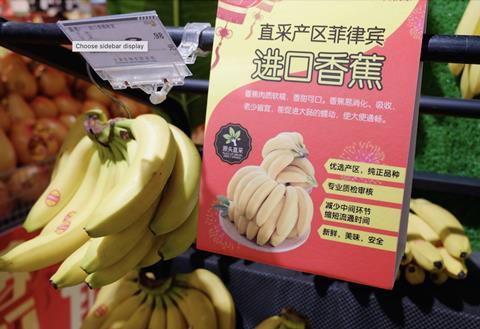
Tropical fruits overwhelmingly lead China’s import profile, representing nearly 80 per cent of volumes in 2025. Bananas were the primary growth driver, increasing 15.1 per cent to 1.94mn tonnes, largely sourced from Vietnam and the Philippines. Strong demand also drove imports of durians, longans and mangosteens, primarily sourced from Vietnam and Thailand.
Temperate fruit imports, which make up the remaining 20 per cent, are largely supplied counter-seasonally by Southern Hemisphere exporters.
Cherry imports, mostly supplied by Chile, surged 30 per cent to 585,000 tonnes, although volumes have softened by more than 10 per cent in early 2026. Apple imports rose almost 20 per cent, led by New Zealand and South Africa, while grape imports were marginally lower overall, with Australia recording a notable 36 per cent increase that helped offset reduced supply from other origins.
Turning to exports, China ranks as the world’s fourth-largest fruit exporter, with shipments dominated by temperate products including mandarins, apples, grapes and pears.
Exports are primarily directed to South-East Asia, Western Asia and Russia. Mandarins led growth, rising 18 per cent to 1.3m tonnes, while grape exports climbed 35 per cent to 801,000 tonnes. Apple exports were slightly lower at 962,000 tonnes.
Beyond fruit, China remains the world’s largest exporter of fresh vegetables, led by garlic, onions, carrots and leafy greens. These exports are heavily focused on South-East Asian markets, including Vietnam, Malaysia, Thailand and Indonesia, and grew 8.6 per cent to reach 9.4m tonnes.