Negotiations on the Comprehensive Economic Partnership Agreement are advancing well, says Iván Marambio
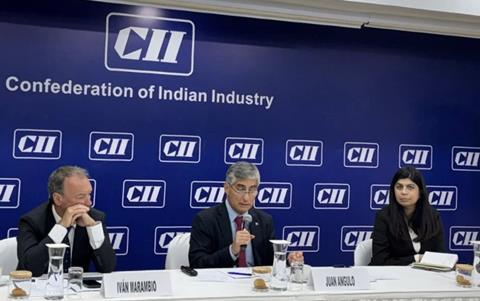
Chile aims to make India its third largest trading partner, on par with the US and China, according to Iván Marambio, president of Frutas de Chile.
Speaking during a recent trade mission to New Delhi, Marambio said he was “very optimistic” about the progress of negotiations on the Comprehensive Economic Partnership Agreement (Cepa), launched in May 2025, to upgrade the existing Preferential Trade Agreement between the two countries.
During the visit, the Chilean public-private delegation, led by Ricardo Mayer, director general of bilateral economic affairs at the Undersecretariat for International Relations (SUBREI), and Chile’s chief negotiator, Pablo Urria, held a series of technical meetings with their Indian counterparts.
Cepa negotiations are said to be progressing at a considerable pace, with four rounds in just six months, demonstrating the significant effort of both countries.
Regarding the challenges facing the Chilean fruit industry in India, Marambio noted that tariff reductions are an important component of Cepa but not the only one. “For India to become a relevant partner, comprehensive work is required that addresses marketing and promotion issues,” he said.
Marambio also pointed to Maximum Residue Limits (MRLs), cold treatment, and logistical challenges. Regarding MRLs, he explained that because India does not automatically apply the Codex Alimentarius standard, but rather reviews MRLs product by product, “this leaves several products below a very low default threshold, causing marketing problems”.
On the subject of cold treatment during transit, Marambio noted: “India does not accept this phytosanitary technique, which is vital to ensuring the quality and freshness of Chilean fruit, posing an obstacle even for products like cherries, which already enjoy zero tariffs. Therefore, this is an area where progress must be made, and we are working with the relevant authorities”.
In terms of the logistics chain, Marambio highlighted the need to secure adequate shipping and air services, as well as an efficient cold chain within India, since without these, “the viability of the business for sensitive products like cherries is jeopardized”.
He said the meetings held with Indian business groups are key to mobilising resources and efforts for the internal improvements that trade requires. “We have met on several occasions with representatives of FIFI and the Indian Chamber of Commerce, and we did so again during the recent trip, as we know it is necessary to promote improvements with the support of the Indian private sector,” Marambio stated.
Looking ahead, Marambio said the next steps in the process include “continuing to negotiate and deepen the relationship with India in a holistic way – encompassing sustainability, art, culture, food security, health, and energy – and intensifying the promotion of Chile and its products.
“Specifically regarding the fruit sector, we will continue working to eliminate non-tariff barriers and to support a successful conclusion of Cepa in terms of market access for Chilean fruit.”