Soma Sengputa, trade advisor at Flanders Investment & Trade, unpacks the true impact of India’s recent free trade deal ‘blitz’
While recent free trade agreements (FTAs) for India have generated attention, especially in manufacturing and services, their impact on fresh fruit has been deliberate and measured.
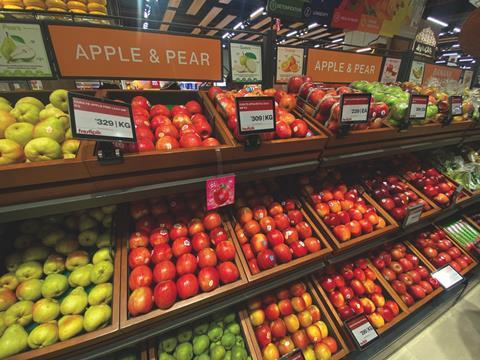
The story is not about opening the gates. It is about adjusting them – slightly, carefully, and with conditions.
In 2024, India imported US$440mn-worth of apples and pears, making it the sixth-largest importer globally, according to customs data analysed by the Observatory of Economic Complexity (OEC). Apples and pears ranked only 196th among India’s overall imported products, which shows something important: fruit imports are visible, but they are not structurally dominant in India’s trade basket.
Yet within horticulture, apples matter. They account for the bulk of fresh fruit imports and serve as a useful lens to understand how India is navigating trade liberalisation.
India’s top suppliers in 2024 were Iran (U$95mn), Turkey (US$80mn), South Africa (US$57mn), Afghanistan (US$44mn) and the US (US$39mn). Chile, New Zealand and several European producers, including Poland, Italy, Serbia, Belgium and Greece, also feature in the mix. This diversity tells us India’s fruit import story is already global. The FTAs are now beginning to reshape the margins of that story.
Complementarity, not confrontation
India’s horticulture production profile is largely tropical and subtropical. By contrast, Europe, Chile, New Zealand, Australia and the US specialise in producing temperate fruits, such as apples, pears, cherries and kiwifruit.
This climatic difference creates complementarity rather than direct competition. Imports often fill seasonal gaps or serve premium urban demand rather than replacing domestic staples outright. That explains why the terms of fruit trade have been negotiated cautiously in every FTA.
European Union: controlled access
Under the EU-India FTA, which concluded in January 2026, apples remain protected but not untouched.
India currently imposes a 50 per cent duty on apple imports. Under the agreement, 50,000 tonnes of EU apples will enter at 20 per cent duty, subject to a minimum import price (MIP) of Rs80 (US$0.87) per kg, according to government sources cited in the Business Standard. The effective landed price remains around Rs96 (US$1.04) per kg, preserving domestic price stability. The quota will gradually rise to 100,000 tonnes over ten years.
Considering India imported roughly 500,000 tonnes of apples in 2024, the EU quota represents an opening, but not a flood.
Pears and kiwifruit receive tariff-rate quotas (TRQs), allowing lower duties within capped volumes, while full duties continue outside the quota.
The EU currently ships around 60,000 tonnes of fruit annually to India, of which roughly 55,000 tonnes are apples. The FTA may increase that number gradually, but it does not fundamentally alter the balance.
The US: broader concessions, practical constraints
The interim US-India trade framework is comparatively more open. Apples and tree nuts may see tariff elimination or significant reductions, though the Rs75-80 per kg (US$0.82-0.87) MIP remains, according to an NDTV report citing commerce and industry minister Piyush Goyal.
Washington State apples dominate US exports to India and have already rebounded sharply after retaliatory tariffs were lifted, reaching nearly US$39mn in 2024. Almonds and walnuts, longstanding US export strengths, stand to gain further.
Yet geography still matters. Freight costs on shipping apples from the US are significantly higher than from Iran or Turkey. Tariff cuts improve competitiveness, but they do not automatically make US apples lower priced than competitors.
Chile and New Zealand: premium expansion
Chile’s preferential trade agreement with India has eliminated duties on cherries and improved access for kiwifruit, pears and avocados. Chile exports roughly 50,000 tonnes of fresh fruit annually to India and has grown shipments by around 40 per cent over the past two years. Apples remain its leading export product to India.
The New Zealand agreement reflects an even more structured approach. For apples, India has agreed to halve the import duty from 50 per cent to 25 per cent under a seasonal quota beginning at 32,500 tonnes, rising to 45,000 tonnes over six years. Full duties and minimum import prices apply beyond the quota. Kiwifruit receives duty-free access within a limited quota, expanding gradually, again with price safeguards.
The most striking part of the New Zealand arrangement is not market access, but the disparity in productivity on fruit production. Average apple yields in New Zealand stand above 53 tonnes per hectare, compared to roughly 9 tonnes per hectare in India. Kiwifruit yields show an even wider gap. In exchange for access, New Zealand has committed to agri-technology cooperation, orchard management, productivity enhancement and supply chain development. The long-term impact may lie more in knowledge transfer than in fruit import volumes.
Australia: structured, slow and limited
Under the India-Australia ECTA, apples remain a sensitive category with phased reductions over seven to ten years and no dedicated TRQ, according to Austrade. Pears and oranges receive limited quota-based concessions. Almonds gain structured access. Volumes remain modest, largely because production costs and freight distances limit price competitiveness.
South Africa: off-season reliability
South Africa has quietly become a major supplier, exporting citrus, apples and pears worth over US$130mn in 2025, according to UN Comtrade data. Citrus exports alone have tripled since 2020, particularly easy peel mandarins and oranges that fill a gap in the Indian market from June to October. Even with 30 per cent duties, logistical efficiency and seasonality keep South Africa competitive.
What the data really shows
When the numbers are placed side by side, three patterns emerge. First, quotas dominate liberalisation. Most agreements offer controlled access rather than open entry. Second, premium categories stand to gain the most. Cherries, kiwifruit, avocados and nuts see clearer benefits. Third, mass-market pricing remains anchored by nearby suppliers.
India’s fruit market is highly price-sensitive. Apples retailing at Rs100–150 per kg compete primarily on affordability. Premium cherries operate in a different consumer segment. FTAs influence the second category more than the first.
Tariffs only part of the equation
Currency movements, particularly the US dollar versus the euro, affect competitiveness. Freight costs often outweigh tariff reductions. A 10 per cent duty cut can be neutralised by a rise in shipping rates. Trade agreements narrow gaps; they do not erase geography.
The deeper shift: technology and productivity
Perhaps the most consequential aspect of these FTAs lies beyond imports. Commitments around agri-technology, planting material, cold-chain systems and yield enhancement could influence domestic production far more than incremental import volumes.
If productivity gaps begin to close, particularly in apples and kiwifruit, the long-term balance may shift inward rather than outward.
A gradual integration
India’s approach to agriculture in its recent FTAs reflects calibration, not capitulation.
Sensitive crops remain protected. Import volumes are capped. Minimum prices safeguard farmer incomes. At the same time, consumers gain wider variety and incremental access to premium fruit. The impact is neither dramatic nor negligible. It is steady.
Over the next decade, the visible effect may not be a surge in imports, but a more diversified fruit basket, stronger supply chains, and a gradual improvement in standards, both imported and domestic.