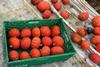
Korea’s pomegranate imports have plummeted in the last decade. Hyojun Kim unpacks some of the causes and outlines what it will take for a comeback
Autumn is approaching, and with it, California’s pomegranate season.
Korea was once a heavyweight buyer of California pomegranates, taking in close to 50 per cent of the fruit at its peak. Today, that share has fallen to around 10 per cent.
Pinning down Korea’s exact import figures is not straightforward. But given how tightly Korea’s quarantine standards limit which origins can enter the market, the broader trend is still traceable. Korea Customs Service data shows import volume falling from 13,596 tonnes in 2013 to 1,805 tonnes in 2025, a drop of roughly 87 per cent.
Export data from the US side (CalAg, UC Davis) points in the same direction, even with a different methodology: from 10,449 tonnes to 2,101 tonnes, a fall of about 80 per cent.
The two sources diverge on the specifics, but not on the direction: Korea’s market for California pomegranates is in sharp decline.
The supplier response

Some point to a simple explanation. Consumers crave convenience, and pomegranates are genuinely difficult to work with. In response, suppliers have developed ready-to-eat pomegranate arils to take the labour out of it, and they now occasionally show up on Korean shelves. But is that the real reason? Is that really enough to explain a decline this steep? And if so, can ready-to-eat pomegranate arils become the game changer that brings the category back to life?
The real cause: Grading gone wrong
Pomegranates used to come in with fairly simple grading: Fancy or Utility. Then, one day, a new grade appeared: X-Fancy. Except X-Fancy wasn’t particularly fancy. Within a single container, Fancy-grade fruit would be covered in scratches while Utility-grade fruit looked cleaner, and even properly sorted lots showed barely any real difference between X-Fancy and Fancy. Importers were left confused.
Unlike retail, where packing centres do the sorting before the fruit ever reaches shelves, wholesale markets receive bulk boxes as-is. That’s where the fights between importers and wholesalers over grading outcomes played out.

There was a time when Korean importers could sell a single ocean container of pomegranates and pocket a margin equivalent to the price of a mid-size sedan. That was the moment importer profitability began to erode.
With margins squeezed and confidence in ordering shaken, importers were left with few options. Cut volume or stop ordering altogether.
The real cause: A fading trend
Korea’s pomegranate craze traces back to a 2006 beverage ad, “Beautiful Women Love Pomegranates” (미녀는 석류를 좋아해). The campaign put an unfamiliar fruit on the map almost overnight.
Korea has an unusual pattern where an obscure fruit’s awareness is often driven more by the FMCG industry than by the fresh produce trade itself.
The image the ad created – an attractive woman eating pomegranate – fed into a belief that the fruit helped replenish female hormones, which in turn fuelled demand for pomegranate-based supplements marketed at menopausal women.
But health supplements are a notoriously trend-driven category, and pomegranate was soon displaced by another ingredient: baeksuoh (Wilford’s swallow-wort). As it happens, my own first career, after university and a stint as a Marine Corps officer, began in consumer healthcare, selling supplements built around this newly launched ingredient. The company that held a near-monopoly on baeksuoh as a raw material, separate from where I worked, had built revenue north of Won100bn (US$73.4mn) on it. Then in 2015, questions emerged over the ingredient’s safety and authenticity, and that company’s sales collapsed to roughly 5 per cent of that figure almost overnight.
What filled the gap afterward wasn’t pomegranate. When a market’s trust in an ingredient collapses, Korean consumers tend to fall back on something proven, and that something was red ginseng. Its flagship brand today, KGC (Korea Ginseng Corporation)’s Hwaerak, generates roughly Won80bn (US$58.7mn) a year. Some Hwaerak products still list pomegranate as an ingredient. But under Korea’s labelling rules, which list ingredients in order of proportion, it appears after the grape concentrate and the various herbal-medicine blends. It’s there for the selling point on the label, added at a level that’s little more than a footnote
Why the supplier’s response can’t hold the dam
Buying fresh pomegranate and preparing it at home is genuinely inconvenient, no argument there. But the declining volume itself leaves Korean consumers with a more fundamental question: why buy pomegranate at all, and what exactly is this fruit to them?
Ready-to-eat pomegranate arils may well be a good way to boost consumption. But a cup holding barely 100 grams of arils will never make up for the thousands of tonnes of lost import volume. When a grading system has broken trust in the supply chain, and the fruit has all but disappeared from shelves as a result, adding convenience alone won’t rebuild that dam.
What needs to happen?
What’s needed is an answer to a more fundamental question. Why should consumers eat pomegranate, and why should they eat it often, not just once among many other fruit choices? This isn’t something a promotion or two, or a bit of added convenience can fix. It calls for the kind of investment and commitment needed to redesign the category from the ground up.
The Asia-Pacific market is a fascinating place to work. Every country differs in language, currency, mood, and regulation. Korea is a particularly distinctive one among them. Find the right approach for this market, move in that direction, and even a category this far into collapse can still stage a real comeback.