Following a successful first season, the company is set to ramp up production in 2026/27 after completing stage two of its plantings
Major international berry company Costa recently completed the first production season for its new growing operation in Laos, making successful trial shipments of blueberries to a number of South-East Asian markets.
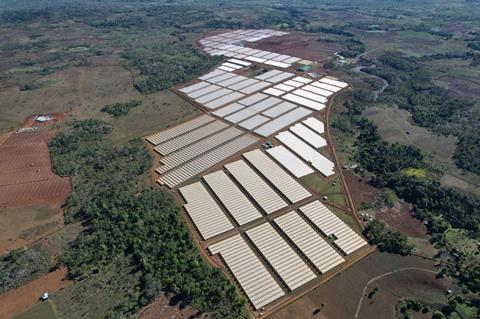
The project is located in Southern Laos on the Bolaven Plateau in Paksong, which is known as the ‘coffee capital of Laos’. Paksong sits at an elevation of around 1,200 metres above sea level and it has a microclimate that enables a blueberry production window spanning October to March. The harvest season begins around three months earlier than peak production from China’s Yunnan province, where Costa has been growing berries for the past decade.
Stage one of plantings covers 17ha, and Martin Glenister, general manager of Costa Berry Laos, said the first harvest, which ran from October 2025 to March 2026, proceeded well.
“Our new team, including a number experiencing their first berry harvest, performed well in managing our blueberry varieties in the local conditions,” he said. “We learnt a lot and this will help to inform our planting strategy going into our second season, with next harvest due in October 2026.
Costa has a globally recognised blueberry breeding programme, which features low- and no-chill genetics, and it has carefully selected varieties for planting to best suit the local conditions, according to Glenister.
“We have several years of trial data from test plots in Paksong that we are utilising to select the best varieties for our planting programme, including those which provide consumers with optimal flavour and size,” he said.
Costa has secured plant variety rights for six blueberry varieties in Laos, and Glenister said it has identified several “standouts” that can deliver strong yields and flavour.
Stage two plantings
Costa Berry Laos harvested trial volumes this year, but production is set to ramp up in 2026/27 as it has now completed stage two of the project with an additional 58ha of plantings. This takes the total area planted to 75ha, and Costa plans to further increase plantings in the next two years to reach a total of 200ha by 2028.
Besides optimal growing conditions, Paksong’s location at 15 degrees latitude also provides proximity by road to key regional markets. The first harvest enabled Costa to trial exports to several South-East Asian markets, including Thailand, Malaysia, Cambodia and Singapore. Fruit was marketed under the Driscoll’s brand through Costa’s partnership with Driscoll’s in these markets.

Glenister noted the ability to harvest, pack and ship fruit to these markets “within a day” is a key advantage. “The timings for nearby markets like Cambodia and Thailand were good; we could get fruit to Thailand overnight in ten hours,” he said.
The earlier timing of Laos production is a key competitive advantage that Costa plans to leverage in these markets when the new season commences in October 2026, he added, while also expanding its reach into other key markets in the region.
Building from the ground up
As a pioneer in establishing berry operations in Laos, Costa has gained a headstart on its competitors, with several other companies now setting up plantations there. But Glenister pointed out that building a berry business from the ground up in the country is no easy feat.
“Laos is a developing nation, which presents some challenges, especially with respect to infrastructure, supply chain and logistics. We are working with government and key stakeholders to find solutions, which are important to realising our future growth plans,” he said.
“First mover advantage comes with the responsibility to develop local government frameworks for the first time for some processes; so we are also learning how to do business locally.”
Sights on China access
Beyond South-East Asia, Costa Berry Laos is also eyeing access to other export markets in the region, with China being a key priority. The Laotian government already lodged an application for market access to China in March 2025.
“As with all market access negotiations, government to government engagement is paramount,” said Glenister. “We have completed initial application procedures for China market access and continue to work with the Laos authorities on this as well as other regional markets, such as India, Japan, Korea and Taiwan.”
Looking ahead, Glenister sees great potential to develop Laos’s position as a key blueberry supplier in the region, and he says Costa is also set to commence trial plantings of rubus and strawberries.
“The business operating environment in Laos in many respects is still an emerging one, but it also represents an exciting opportunity, with the country well positioned to leverage and benefit from its geographical proximity at the heart of South-East Asia,” he concluded.