High consumption potential, bright prospects for brands, and growing intra-Asia trade highlighted across insight-filled programme
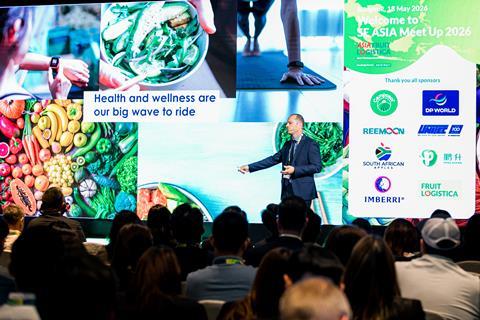
Younger demographics, health and wellness trends, and the expansion of digital trade in South-East Asia were among the key themes of the Asia Fruit Logistica SE Asia Meet Up on 18 May 2026 – signalling new opportunities for brand growth across the region.
The conference and networking event – which took place at the JW Marriott Hotel Bangkok – brought together almost 250 decision-makers from over 30 countries for an information-packed day of talks and discussions.
The SE Asia Meet Up got underway the day before the conference with the AFL DP World Fresh Produce Golf Cup, providing a relaxed setting for senior leaders to connect, and it concluded with study tours offering an immersive look at Thailand’s fresh produce supply chain on 19 May.
The conference programme – curated by Asiafruit Magazine – opened with a welcome address from the director-general of the Thailand Department of Agriculture Rapibhat Chandarasrivongs, where he highlighted the significance of South-East Asia in the world’s fresh produce trade.
“South-East Asia has emerged as one of the most dynamic regions for fresh produce production, trade logistics and innovations,” said Chandarasrivongs.
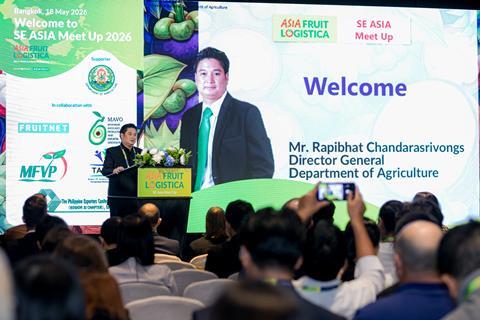
“On behalf of the Department of Agriculture of Thailand, Ministry of Agriculture and Cooperatives, I would like to express our sincere appreciation to Asia Fruit Logistica and all the partner organisations for organising this important platform, which brings together key stakeholders from across South-East Asia and beyond,” he added. “This event reflects the growing importance of regional cooperation in strengthening the fresh fruit and vegetable industry across the Asia region.”
Dynamic consumer markets
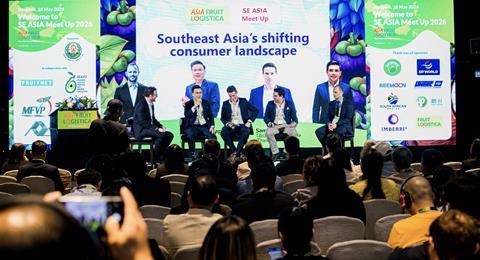
The programme kicked off with a deep dive into South-East Asia’s shifting consumer landscape delivered by Carlo Magni of Forward Insight & Strategy.
Magni shared that the median age of the 700mn people who call South-East Asia home skews younger than that of Europe or other markets in Asia such as China and Japan, which opens up new marketing opportunities.
“What we see is that millennials, Gen Z, and Alpha continue to gain share of population and this is driving much of the produce category growth,” he said.
Magni’s research found that these younger generations are eating fresh produce more frequently, which has largely been driven by growing health and wellness trends.
“We’ve got a high proportion of people that tell us they want to reduce sugar and salt, they exercise more at the gym, they take vitamins and supplements, they want to reduce processed foods and increase their daily consumption of protein, as well as buy organic and clean label foods.”
He recommended targeting younger consumers with marketing and education campaigns so that there is a longer relationship with the brand over their lifetime. “Demographic shifts are very important,” he said. “Engage early, and tailor to the younger.”
Convenience and safety are also key trends for the South-East Asia market, which Magni encouraged brands to consider in their messaging and packaging.
“Safety is still a crucial issue in the region, but it looks like a bigger issue in Vietnam,” he said. “And that’s where brands can really make a difference. Building trust, by providing transparency and evidence, can truly provide consumers reassurance that what they buy is safe.”
And while price continues to be a focus, particularly amid growing global volatility, Magni suggested there is a growing market for premium offerings.
“Our research shows consumers are prepared to pay a premium if we are able to position products in a way that is relevant,” he said.
Magni was then joined by Gunn Vitidphapatumrong of Thai retail giant CP Axtra, Sam White of T&G South East Asia, and Jose Vottero from Fresh Fruit-X in a lively panel discussion to unpack the topic further.
Going digital: new ways to build brands
Ryan Molloy of Redfern Digital led a session on digital marketing in South-East Asia, offering a strategic overview of the fast-evolving digital and retail landscape for fresh produce in the region.

Across South-East Asia, three in five people shop online and over 60 per cent of all transactions in the region are now digital. However, the market share of e-commerce for fresh produce and groceries remains generally lower than 5 per cent.
“I think the retailer movement has been one of the bigger changes that we’ve seen online,” said Molloy. “Retailers often will be the leaders of categories going first into e-commerce and we are now seeing this strongly across all regions for fresh fruit and produce.”
Livestreaming continues to be one of the leading sources of gross merchandise value (GMV) in the region, with significant investment into this platform in recent years.
“Content commerce has become the central pillar of e-commerce, driving an estimated US$49.7bn, which is 32 per cent of platform GMV,” Molloy said. “TikTok Shop’s expansion and Shopee’s investment in livestreaming have pushed this growth.”
Robust growth for tropical fruit trade
After a networking lunch, the focus shifted to Asia’s booming tropical fruit trade. Ling Ma of leading importer-marketer Goodfarmer Group provided an update on China’s surging demand for tropical fruits, which saw imports of bananas and durians increase by 15 per cent and 20 per cent respectively in 2025. While China is already the world’s largest tropical fruit importer, the market holds “huge” growth potential, Ma noted, with per capita consumption still below the global average.
Stephen Antig of the Pilipino Banana Growers and Exporters Association (PBGEA) shared how the Philippine banana industry is maintaining market share amid considerable geopolitical challenges and ongoing concerns over TR4 disease. Independent journalist Beimeng Fu then shared her findings from a long-term project looking at how China’s booming demand for durian is driving expansion of production in newer origins such as Laos. She encouraged companies to invest early in stronger due diligence, understand local land systems, participate in community engagement and uphold environmental compliance to build more resilient supply chains and stronger long-term market positions.
Delegates also heard how Latin American fruit suppliers are stepping up their efforts to expand into South-East Asian markets with a panel discussion featuring Erick Aponte (PromPerú/Asean), Gonzalo Matamala Ortiz (Frutura Asia), Julio Bellota (DP World), and Wongsakorn ‘Bill’ Chatamornwong (City Fresh Fruit).

Berries: the next frontier
The final session explored South-East Asia’s emergence as a new frontier for the global berry industry. Dani Geng of Joy Wing Mau Group outlined China’s transformation into the world’s largest blueberry producer and its export push into the region.
The domestic market continues to absorb the vast majority of China’s surging production, but with penetration now “fairly mature”, export development has become a priority for the industry.
“China’s blueberry export volume continues to grow faster in the past three years,” Geng said. “The average growth of those three years is 160 per cent.”
The focus for exporters has been investment in superior genetics, supply chain upgrades and branding, he added.
“With the joint efforts across supply and sales chains, we can enhance the growth of China’s blueberry industry and unlock enormous business potential in South-East Asia market,” Geng said.

Martin Glenister of Costa delivered a case study on the company’s pioneering new blueberry growing operation in Laos. He said the emerging high-growth market in South-East Asia was a key factor when considering investing into production, given the export opportunity from Laos to the region.
“Why Laos? Latitude 15 provides seasonal advantage. Our harvest period is between October and March annually,” he said. “The altitude and climatic suitability above 1,000 metres supports the berry quality and the strategic location enables us to reach regional markets by truck from Thailand right through to Singapore.”
And, while there have been some challenges developing the project, not least dealing with high rainfall in the first year and disease pressure, Glenister said the team is learning and growing.
Geng and Glenister were then joined by Hendry Sim of leading Indonesian importer Laris Manis Utama for a discussion on the region’s fast-evolving berry consumption landscape.
AFL Fresh Produce Golf Cup 2026
The day before the conference, delegates met for the AFL Fresh Produce Golf Cup, which was sponsored by DP World. Delegates from over 20 countries enjoyed the relaxed setting for connection before the conference as well as a chance to workshop their skills.

Study Tour offers first-hand insights
The SE Asia Meet Up wrapped up with the Industry Study Tour on 19 May, providing an immersive look at Thailand’s fresh produce supply chain. Delegates visited Talaad Thai Market, South-East Asia’s largest wholesale market, before touring some of Bangkok’s top food retail stores. The curated tour took in a variety of formats, with hosted visits to Makro, a leader in the cash and carry channel, a Lotus’s hypermarket, and a Tops Food Hall premium supermarket store. Delegates were able to gain first-hand insights into Thailand’s sophisticated retail market and engage with senior buyers while enjoying valuable, extended networking opportunities.
The SE Asia Meet Up was co-organised with Fruitnet in collaboration with the Myanmar Avocado Producer and Exporter Association (MAVO), Myanmar Fruit, Flower and Vegetable Producer and Exporter Association (MFVP), Thai Agricultural Wholesale Market Association (TAWMA) and The Philippine Exporters Confederation (PHILEXPORT).
Asia Fruit Logistica has announced the Southeast Asia Meet Up will return to Bangkok in 2027, taking place on 10-11 May, with further details to be announced in due course.


