Exports reach record value while the fruit tops fruit sales across major domestic retailers
Korean strawberry exports reached record heights in 2025, while maintaining a top position in domestic sales, according to a report from local publication Korea JoongAng Daily.
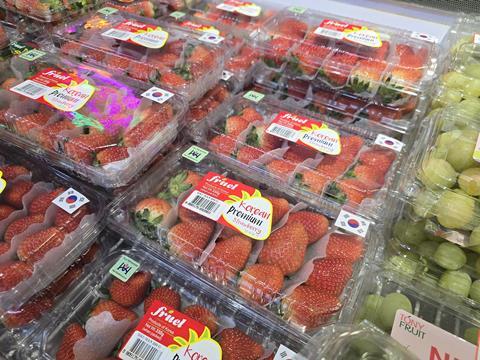
Korea Agro-Fisheries & Food Trade Corporation reported Korea’s strawberry exports reached US$72mn in 2025, marking significant growth from the US$4.4mn earned in 2005. Key markets included Thailand, Singapore and Hong Kong, which accounted for the largest share of shipments in 2025.
A Ministry of Agriculture, Food and Rural Affairs (Mafra) release said exports of new strawberry varieties such as “Honghee” and “Vitaberry,” as well as exports of the flagship strawberry variety “Geumsil” had expanded in ASEAN markets.
It added that Korean strawberries had gained recognition as premium fruits with high sugar content and rich juice, particularly in Thailand, Singapore, and Vietnam.
Nonghyup Trading, a leading Korean exporter, told Korea JoongAng Daily strawberries grown in hot and humid countries lack sweetness.
“They struggle to match the sugar content and quality of Korean strawberries,” a representative said.
Domestically, strawberries were again the top selling fruit at E-Mart, Homeplus and Lotte Mart stores, a position the category has held for three consecutive years.
The fruit has also gained popularity in the food service industry with viral dessert such as Seongsimdang’s strawberry cake and fresh strawberry mochi filled with Dubai chocolate intensifying competition among retailers to secure high-quality strawberries.
This top position has been held despite rising prices over winter as colder weather constrained shipments and supply.
The retail price of strawberries averaged Won2,278 (US$1.57) per 100 grams in early February, thanks to a cold snap. This was up 17.8 per cent on the price a year earlier, according to Korea Agro-Fisheries & Food Trade Corporation.
In line with rising demand, Mafra has said it plans to expand smart farms – high-tech greenhouses equipped with sensors, AI-based controls and automated climate systems – as well as upgrade its seedling cultivation technology to help boost supply. NongHyup has also invested in entry-level smart farm programmes, jumping from 14 participating farms in 2023 to 329 in 2025. “Strawberries soften easily depending on temperature and humidity,” a NongHyup representative told Korea JoongAng Daily. “Entry-level smart farms help farmers maintain optimal growing conditions through automated ventilation systems and nutrient solution controllers, even remotely, which improves quality.”
According to the Rural Development Administration (RDA), adopting smart farm technology could boost grower income. RDA said smart farms that apply nine core technologies, including AI-based environmental control systems, could raise output by up to 83 per cent, when compared to conventional greenhouses, increasing annual net profit by as much as 3.5 times.
“To increase income for strawberry farmers, producers must expand winter output, when prices run higher, and that requires precise environmental control,” Cho Yong-bin, director general of the agricultural engineering department at the RDA, told Korea JoongAng Daily. “If we significantly raise productivity in strawberry greenhouses through AI convergence technology, young and startup farmers can expect stable and competitive income comparable to urban workers.”
To adopt all nine technologies, growers must invest approximately Won660mn (US$454,953) per 3,300 square meters (roughly the average greenhouse size). But, the RDA said, growers can recover this investment within three to four years if they meet annual production targets.