Hyper-premium hydroponic-grown melon offers alternative to imported Japanese fruit
Indonesian importer-distributor Laris Manis Utama (LMU) has launched Indonesian-grown Kirin melon, a fruit associated with Japan’s hyper-premium market, under its MyFruit brand.
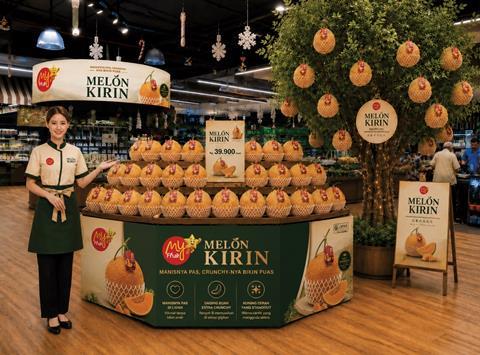
Kirin melon is traditionally grown in warm temperate climates, but by incorporating hydroponic growing technology, LMU says it’s been able to produce fruit in line with Japanese quality standards, even within the constraints of Indonesia’s tropical conditions.
According to Hendry Sim, vice director of LMU, this premium grade is attained using the Nutrient Film Technique, a contemporary hydroponic technology extensively used in agriculture which promotes ideal growth.
“The method ensures uniformity,” he says. “It enables plant roots to get precisely measured and uniformly distributed nutrients and oxygen.
“Unsurprisingly, the resulting quality matches that of imported fruit, with uniform flesh thickness.”
Harvest on the new line began in early August at a rate of five tonnes per week with output projected to increase to 30–50 tonnes by early 2027. Beyond that, LMU will continue to increase production in response to market demands.
Despite ongoing pressure on purchasing power from rising living costs, demand for healthy food is increasing in Indonesia, particularly among middle-to-upper income consumers. At the same time, Japanese, Korean, and Western cuisines are also gaining popularity, driving demand for high-quality imported ingredients. However, regulatory barriers and import licensing requirements pose considerable challenges for market entry.
For LMU, developing premium Indonesian-grown production meets this consumer demand, while bypassing the challenges and higher costs associated with imports.
Although demand remains strong, the fruit’s hyper-premium status means specific distribution, marketing and merchandising is needed to reach the intended target market.
“Without effective distribution, the melon would be difficult for the general public to enjoy,” Sim explains. “LMU plays an important role in this regard by leveraging its national contemporary retail network.”
LMU uses durable, impact-resistant packaging including partitioned boxes and protective foam netting to ensure quality is maintained.
Following a soft launch in early-August, the line was officially launched on 29 August alongside a multichannel promotion strategy.
“The product launch used sales promoter uniforms, in-store branding on fixtures, pillars, banners, point-of-sale material, floor displays and eye-catching fruit displays,” Sim says.
The ongoing campaign will also incorporate a range of out-of-store initiatives including branded vehicles and digital content alongside extensive in-store branding and sampling opportunities.
“Product introduction will reach a larger consumer base through these different techniques, in addition to retail shoppers,” Sim says.
LMU will work with supermarkets across Jakarta, Bekasi, and South Tangerang to launch the promotions.
“These three cities were chosen based on market reach and potential,” Sim explains. “Moving ahead, the promotion will expand beyond those three areas to be available nationwide.
“With a present supply capacity of 40 tonnes per month, which is expected to increase to 400 tonnes, LMU seeks to meet market demand throughout the year.”
This article appears in the upcoming edition of Asiafruit Magazine. For more coverage on Indonesia’s fresh produce market subscribe HERE.