Red Sea and Hormuz disruptions have redrawn trade routes, and market recovery is several years away, says Del Monte chief
Red Sea route disruption over recent years, followed by the closure of the Strait of Hormuz after the war broke out in late February, have fundamentally redrawn the landscape of the Middle East produce trade – and the Gulf Cooperation Council (GCC) markets have changed forever.
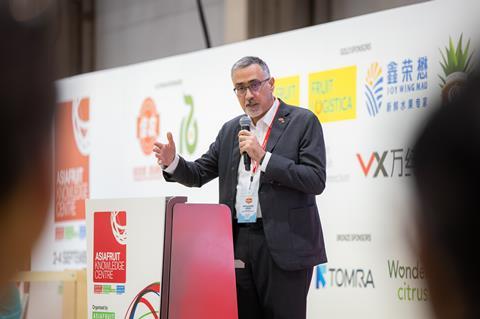
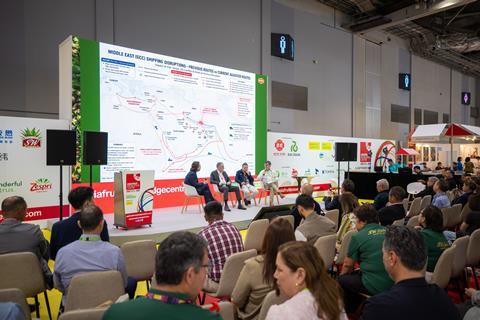
That was the stark message from Mohammed Abbas, president and COO of Del Monte Corporation, who led a session at Asiafruit Knowledge Centre looking at the war’s impact on the Middle East markets, and the route to recovery.
The Middle East market is heavily reliant on imports, Abbas noted, importing some 90 per cent of the fresh fruit and vegetables it consumes. Around 70 per cent of the region’s produce has been imported through the Strait of Hormuz, with the balance shipped via the Red Sea and trucked from Europe.
“Two years in the making”
Abbas explained how shipping routes via the Suez Canal to the Red Sea ports of Jeddah and King Abdullah along the western coast of Saudi Arabia were already disrupted two years ago. “All [imported] produce coming from the West – be it Europe, South Africa, South America or the US – has been going around the Cape of Good Hope rather than through the Suez. That added longer transit time coming to the GCC, and higher shipping costs.”
The closure of the Strait of Hormuz in March – and its continued closure – have caused a whole new level of disruption, he explained, impacting all GCC markets and “creating a mess producers are still suffering from today”.
“It’s no longer about ‘can we get to the Middle East or can we serve the GCC?’,” said Abbas. “It’s about how long does it require in terms of transit time? What is the cost of shipping? And can we reach the end-consumer with a fruit that’s still alive, that’s still fresh? That is the major challenge.”
“It’s no longer about how much you’re paying in terms of rate premiums, insurance, or transit times. It’s about are we arriving in the region within the required shelf-life?
“This is where everyone is suffering now. Everyone has issues with the quality of food arriving there. The cost to land fruit there is so high. Freight rates are going up by ten or even 20-fold from certain origins.”
From import hub to diversified routes
Abbas said the market had undergone several key shifts over the past 200 days since the war broke out.
Jebel Ali, formerly the hub serving the entire region, has been superseded by multiple entry ports, including Fujairah, Khor Fakkan, Salalah, Jeddah, and King Abdullah Port. “Since the shutdown [of Hormuz], trucking is the game – rail and trucking from all these points,” he noted.
Unfortunately, these ports do not have the container plug-in capacity to handle the significant surge in volumes. “This is where you’re seeing congestion happening, with up to two weeks of ships waiting to enter and discharge food,” said Abbas. “That only increases cost and deteriorates the shelf-life of fruit.”
“If you’re shipping apples or citrus, it’s fine. You can survive the longer transit times, but in our case, with bananas or pineapples, you have an issue with every single arrival.”
Consumption holds up
Consumption levels across the region have remained strong, Abbas observed, but inflation has increased because of the shipping, insurance and transit time, as well as quality deterioration. Saudi Arabia was comparatively less affected, with Qatar and the UAE experiencing notable inflation.
Abbas said the Middle East market would remain a multi-gate entryway from hereon in. “Regardless of whether the war stops today or not, the GCC is no longer as it used to be as a region. It will continue to use the multi gateway of all these new entry points, be it rail, truck or sea. You’re going to see that tremendous shift.”
The Middle East saw a surge in air shipments in the wake of the ocean disruption, particularly for premium and highly perishable products. Abbas said these ‘airbridges’ would remain vital, although use would be more restricted to niche items.

From just-in-time to inventories
Food security means expanded warehousing and more plug-in capacity for containers are critical. “The concept of just-in-time is gone. We can never go back to this. The key now is to keep produce in an inventory buffer of three to six months,” said Abbas. “This is one of the issues that’s going to impact cash flow, and we can all feel it. There is so much money being frozen in higher inventory levels.”
He also predicted a change in eating habits and a shift towards frozen and shelf-stable products, particularly among consumers “on medium to low incomes” who can no longer afford a “30-40 per cent surge in the cost of products”.
Contracts for doing business in the region are also being rewritten, with force majeure clauses and insurance provisions being added as standard procedure.
The other key shift Abbas outlined is a growth in local supply. “It started when Covid hit and a lot of governments locked down on exports of fresh produce and food products,” he said. “This is going to continue driving GCC markets to invest in localising supply. Can the GCC shift from 90 per cent to 60 per cent dependence on imports? That’ll require a heavy investment in the future, but we already see some measures to get there. And since Covid, we’ve seen serious investments in greenhouse production and indoor farming.”
Three stages to recovery
Concluding his talk, Abbas forecast a long road to market recovery, outlining several stages to overcome once the war ends.
“First, we must get through the political resolution. Then, there comes the insurance gate. When insurance companies drop the insurance premiums, that’s when shipping lines will start considering to return to normal,” he said.
“When and if that happens, we go to the third gate, which is capacity. There are so many empty and displaced containers around the world because of the war. For that pipeline to return, we’re talking about a longer period.
“To me, if the war ends today, the whole of 2027 would be a year of recovery, but only in 2028 would we see the norm come back.”