Varietal development is considered vital to sector security
Retailers are calling for more resilient potatoes in the face of key chemical withdrawals.
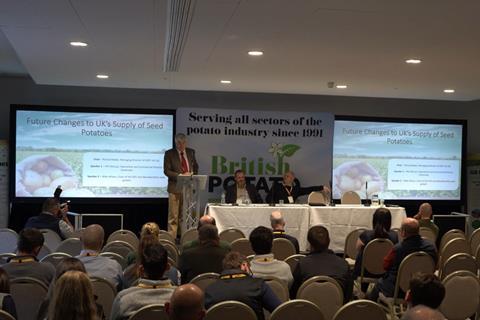
That was one of the key messages at the British Potato Event, where Phil McCaul, operations and commercial director at Greenvale, told the audience that the removal of products such as Nemathorin could reduce the British potato area, leaving supermarkets concerned.
“We can think of instances in recent years where there’s been gaps on the shelves either through yield problems or quality problems, and there’s an increasing realisation that something has to change to make sure retailers have potatoes on the shelf 365 days a year,” he said
McCaul noted that the British potato area has fallen by almost a quarter over the last few years and a worst-case scenario is that there will be another reduction of more than 40 per cent within 10 years.
He expected the fresh potato sector to come under the most pressure because of the higher quality required, and that there were fewer resistant varieties in the fresh rather than processing sector.
“There’s a broad acceptance that variety development is critical to sector security,” he said. ”I think it’s been surprising to some retailers actually how long that takes, how forward-looking you have to be, how you have to try to pre-empt what’s going to happen in the future.”
Consistency and availability are very important to consumers, McCaul added, with Greenvale research showing that usage guidance on packs is valued more than a specific variety. However, that does not exclude the development of new named varieties.
Ideal seed conditions
At the GB Potatoes seminar, entitled ‘Future changes to the UK’s supply of seed potatoes’, Aberdeenshire seed potato grower Mike Wilson said that his region is ideal for growing some of the best seed potatoes in the world, but it is not an easy process, with some varieties abandoned after a year or two of growing because of unsuitability.
“Poorer yields in 2025 affected costs and while we were less exposed to the decline in demand from Egypt for seed and a drop in price, than others, it has dented returns for seed growers,” he explained.
In the longer-term, climate change is a concern, Wilson warned, with the spread of aphids a particular problem.
The complexity of seed growing means that his farm grows 35 different varieties, some taking up a few hectares and others in small strips. His rotation includes grass, which he said is excellent preparation for a potato crop, while the income that cattle have provided in his mixed system have helped the business over the last few years.
Growing strong and vigorous seed for his clients is key to Wilson’s business and this has a focus on reducing the number of generations it takes to deliver commercial seed. That has included reducing the number of years that mini-tubers are grown from three to two years, although that does add cost to the system.
While there are inevitable challenges of a changing climate, greater risks and fewer crop protection options, Wilson was still confident that Scotland can continue to deliver the best seed in the world, aided by investment by seed companies and support from organisations such as the James Hutton Institute and the Scottish government’s SASA.