Food and farming must be embedded in Burnham’s 10-year plan, union president tells defence experts and armed forces
Britain’s declining domestic food production is leaving the country increasingly vulnerable to conflict and major supply chain disruption, the NFU has warned.
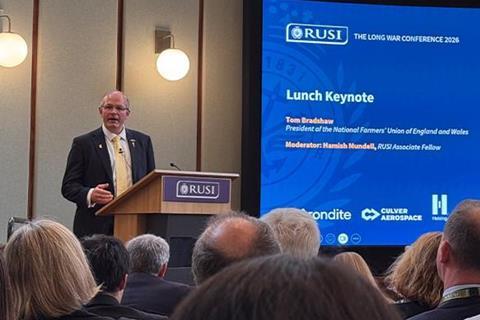
In a keynote address at the Royal United Services Institute (RUSI) conference, NFU president Tom Bradshaw addressed defence experts, senior members of the armed forces and politicians.
“The food system is already under attack. In the last few years, we have seen food used as a weapon of war,” Bradshaw said.
He highlighted how disruption to global supply routes and attacks on storage and distribution infrastructure had driven up costs of producing food domestically.
“For many years, food security has been treated, by governments of all colours, as something we don’t need to worry about - we’ve taken it for granted. Those assumptions have shaped the UK’s food policy for decades. They are no longer fit for purpose.”
Bradshaw warned that Britain was becoming increasingly dependent on food produced overseas, despite growing instability in global supply chains.
The NFU’s recent ’Ready To Grow’ report found that across 10 of 11 key agricultural commodities, the proportion of the nation’s food produced domestically had fallen over the past 30 years.
He warned that declining domestic production also threatened the loss of vital agricultural capacity, including processing facilities, farming businesses, skills, infrastructure and generations of industry knowledge.
Embedding food and farming in the Prime Minister’s forthcoming 10-year plan, due to be published before Christmas, would be key to maintaining capacity, Bradshaw emphasised.
“It’s unimaginable that the food system would not be a part of that plan,” he said.
He urged the government to begin with an assessment of the food production capacity Britain would need during a “serious and prolonged disruption”, as well as setting a target for domestic food production and “fac[ing] up” to the investment required.
Above all, he called for a long-term partnership between government, farmers and the wider food supply chain to come together to create resilience.