Asia’s internal production and consumption are entering a positive spiral of growth, reshaping the fresh produce trade across the region
For many years, the fresh fruit business looked at Asia mainly as a destination market: China for cherries, South-East Asia for grapes, and a growing group of premium cities for berries and stonefruit. But today that view feels too narrow. Asia remains the most compelling demand story in the world, yes – but it is also becoming a more integrated production and distribution system in its own right.
In 2024, Asian markets imported 17.3mn tonnes of fresh fruit, and 12.5mn tonnes of that volume was traded within Asia itself. In other words, nearly three-quarters of Asia’s fruit import business is already Asia supplying Asia.
Why does this matter now? Because the global environment has changed, and it does not seem likely to go back to what it was before. Freight volatility, tariff risk, geopolitical fragmentation, tighter working capital, lower returns, and more cautious consumer spending are all pushing the industry in one direction: pragmatism. And pragmatism goes hand in hand with proximity.
In fresh fruit, shorter distance is not only a logistics advantage. It is also a commercial advantage. It reduces quality risk, improves inventory rotation, and makes it easier to build sustainable programmes instead of depending only on counter-seasonal windows. China-Asean trade exceeded US$1tn for the first time in 2025, and both sides are openly pushing customs facilitation and greater use of Regional Comprehensive Economic Partnership (RCEP) rules to move high-quality fresh products more efficiently.
China: buyer and supplier
The first major anchor is China. Too many people still speak about China only as the buyer at the end of the chain. But China is now both the biggest demand centre and one of the most important competitive supply bases in the region. Analysis from the Asiafruit Statistics Handbook 2025 shows China imported 6.3mn tonnes of fruit in 2024 while exporting 4.7mn tonnes. In grapes, the shift is even more visible. The USDA forecasts China’s table grape crop will reach 15mn tonnes in 2025/26, with exports continuing to grow, led by shipments to Vietnam, Thailand, and Indonesia.
More importantly, China’s varietal portfolio is upgrading very fast. The story is no longer only about Shine Muscat. Growers are moving into Autumncrisp, Sweet Globe, Sable, among others, while also developing local favourites such as Shenyu and Crystal. This is not a minor adjustment. It is a structural signal.
Thailand-Vietnam tropical fruit corridor
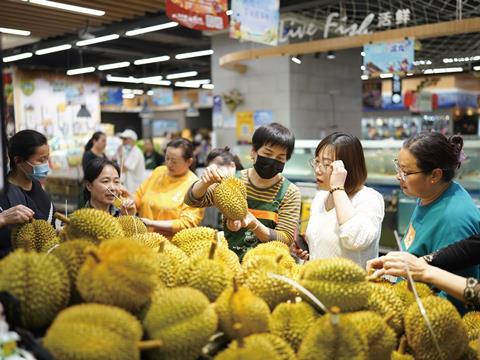
The second anchor is the Thailand-Vietnam tropical fruit corridor. If there is one category that shows what intra-Asia integration looks like in practice, it is durian. Thailand remains the benchmark supplier to China, but Vietnam has closed the gap very quickly because it combines proximity, lower logistics friction, and the ability to extend supply through different producing zones.
Asean also remains China’s main external source of fruit. This matters beyond durian itself. It shows that when protocol access, land-border execution, and commercial alignment come together, Asia can build scale very fast from within the region.
South-East Asia’s consumption belt
The third anchor is the South-East Asian consumption belt itself, especially Vietnam, Indonesia, Thailand, and the Philippines.
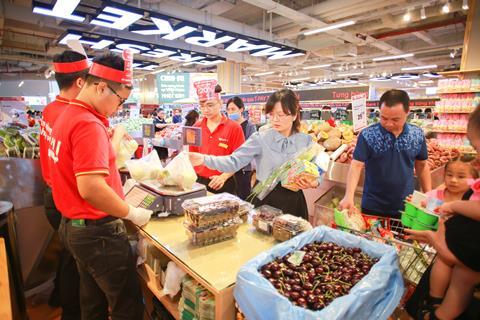
These are no longer secondary markets. They are becoming a strategic urban demand zone for Chinese fruit, Asean tropicals, and selected premium imports. In 2024, Vietnam’s fruit imports surged 38 per cent to 1.9mn tonnes, overtaking Japan to become Asia’s second-largest importer after China. Indonesia and Thailand also posted double-digit import growth, driven largely by Chinese citrus, apples, and grapes.
The grape trade is especially telling. Vietnam remained the largest importer of Chinese grapes in 2025, buying around US$220mn, with Indonesia and Thailand following behind. This is important because it shows how regional trade is not only growing in volume, but also becoming more diversified and commercially deeper.
India’s emerging supply role
The fourth anchor is India. India will continue to be seen mainly as a large domestic market, but it is also one of Asia’s most disciplined grape exporters and, over time, can play a bigger regional role. The USDA forecasts India’s table grape exports at 350,000 tonnes in 2025/26, while Apeda’s recent dashboards already list Vietnam, Thailand, and Indonesia among India’s top-ten grape destinations.
Today those numbers may still look modest compared with Europe. But strategically, the signal matters. India’s role in Asia’s fruit map is likely to become more relevant, especially as regional buyers continue looking for reliable supply closer to home.
None of this means Asia will replace Southern Hemisphere fruit altogether. But as intra-Asia production expands, these categories will likely have a broader presence across the calendar. They will become more available, and more affordable. Over time, that will reshape consumer habits and price expectations across the region.
For Southern Hemisphere shippers, the challenge will not be only to supply fruit in the off-season. The real challenge will be to keep reminding consumers why that fruit still deserves a premium during those counter-seasonal windows.
The future is not Asia closing itself. The future is Asia becoming more capable of relying on Asia first.