Trade policy must not protect Dutch and South Africans at expense of Spanish farmers, says José Antonio García
The Netherlands has established itself as one of the main gateways for citrus fruits from third countries into the European Union market. Its logistical and port infrastructure has enabled it to develop a powerful model for importing, brokering, and marketing citrus fruits to other member states.
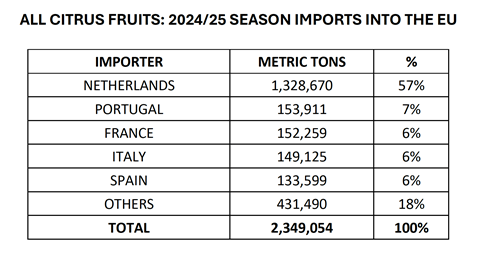
During the 2024/25 season, more than 2.34mn tonnes of citrus fruit – oranges, lemons, grapefruits, mandarins, and limes – were imported into the EU. Of this volume, more than 1.32mn tonnes entered through Dutch ports, representing approximately 57 per cent of the total.
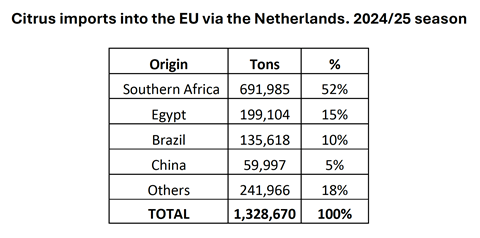
South Africa’s main trading partner is the Netherlands. Or perhaps it’s the other way around: the Netherlands’ main trading partner is South Africa. Or maybe there really is a nearly perfect partnership – but one in which only the Netherlands wins. South Africa is heavily dependent on its Dutch partner, a relationship that exposes the former to significant commercial and reputational risks.
Obviously, most of this volume is not intended for consumption in the Dutch market (which has a population of just 18mn), but rather for subsequent redistribution to other European markets. This commercial activity is legitimate, but one may question the impact it has on the balance of the European market when the increase in imports creates surpluses and coincides with the European production season, putting downward pressure on prices, undermining the principle of counter-seasonality, and, in practice, reducing the preference for citrus fruits produced in the EU.
The problem is not importing. The problem is how, when, and under what conditions these products are imported and redistributed. The result is clear: the economic risk of oversupply falls on European farmers, primarily those in Spain. There could also be other unintended consequences (image of the product’s origin, reputation, perception of phytosanitary risk…), in addition to market tensions that would justify a response at the political level.
Two trade models and a fundamental issue
There is a substantial difference between the Dutch model of intermediation or brokerage – based on the massive importation of citrus fruits from the Southern Hemisphere (primarily from South Africa, but also from other sources such as Egypt and Morocco) and their subsequent redistribution in a spot market – and the planned supply models operating in other member states, such as Spain. The concentration of Dutch operations in the spot market creates significant imbalances between supply and demand when imported volumes clash with European production.
The result is direct pressure on prices and, consequently, on the profitability of European farmers. In Spain, France, and Italy, a significant portion of imports is directed toward meeting European consumption during the off-season through planned and coordinated supply programmes between importers and supermarkets. The goal is to ensure product availability year round, maintain consumption levels, and respect the logic of off-season supply, giving priority to European produce when it is available. We are not, therefore, facing a debate over whether or not to import. We are facing a debate about market balance, risk sharing, the competitiveness of the citrus sector, and the responsibility of the main supplier to the citrus market – in this case, shared between the Netherlands and South Africa.
The EU must analyse whether the trade dynamics within the European market are generating effects incompatible with the economic, social, and environmental sustainability goals to which European producers are strongly committed.
The spot market cannot be allowed to determine the future of Spanish farmers
There is a political issue here that it must address: is it reasonable for the profits made from intermediation and re-export to remain in the hands of speculative operators while a substantial portion of the economic risk arising from oversupply is borne by farmers? The answer cannot be yes. European producers cannot become the adjustment variable in a trading system whose primary incentive is to increase the volumes moved by the market – a model based on generating commissions based on fruit volumes and on generating business for Dutch logistics and port services.
Nor should we forget that this model will clearly harm third-country producers themselves. When the strategy consists of importing large quantities of product into an already well-supplied market, the pressure on prices will ultimately affect both European farmers and producers in third countries. Undoubtedly, the prices received by South African or Egyptian farmers will also be negatively affected by the dynamics of the Dutch model.
Interestingly, Dutch operators never lose out. It is clear that this is a business model that is neither sustainable nor socially acceptable.
This year’s lemon market experience calls for a policy response
What happened during the summer of 2026 – with record volumes of South African lemon imports into the EU – should serve as a clear wake-up call.
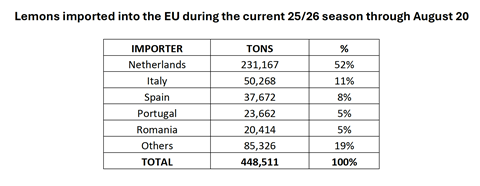
In the current 2025/26 season to 20 August, the EU has imported 448,000 tonnes of lemons from third countries, of which the Netherlands has handled 231,000 tonnes (52 per cent), mostly from South Africa – a record figure that has created significant inventory by far exceeding market demand. This undoubtedly hinders the start of the season for European-grown lemons, as the fruit faces competition from substandard South African lemons that have been stockpiled for several weeks in Dutch ports and are being sold at clearance prices due to the lack of incentives resulting from a consignment-based business model.
The EU must move toward a system that allows for the reconciliation of commercial activity and the year-round availability of citrus fruits with responsible management of import flows.
European agriculture cannot be the hidden cost of logistics efficiency
The European Union needs an open, competitive, and efficient market. But an open market cannot be a market without rules to ensure balance. Europe must defend trade and ensure that consumers have access to high-quality citrus fruits with quality and phytosanitary guarantees, but it must also defend European producers. It must ensure the year-round availability of citrus fruits, but without allowing the commercial planning of third countries to ultimately undermine the profitability of EU harvests. And it must protect the free movement of goods, but without allowing the competitive advantage of certain logistics hubs to be built at the expense of farmers in other member states.
José Antonio García is CEO of Ailimpo, Spain’s interprofessional organisation for lemons and grapefruit