A ‘good shipping’ charter is a welcome step forward, but it needs importer-focused measurements to succeed, says Edouard Brière
The Global Coalition of Fresh Produce presented its Charter of Good Shipping Practices at Fruit Attraction earlier this month. For importers, the test of any such charter is on the quay, where reliability means one thing: is the container there, cleared and usable when the plan says it will be?
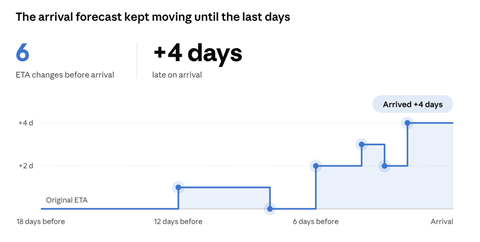
Picture a reefer of blueberries from Callao on its way to Rotterdam. On the carrier’s website, it is on time. But over the last ten days its ETA has moved three times. The vessel waits a day for a berth. The phytosanitary certificate arrives the morning after discharge.
By the time the box is cleared, the haulier slot you had booked is gone, the distribution centre has re-planned its week, and a customer order has gone out short.
None of that shows up as a late vessel. All of it shows up in the importer’s costs.
What unreliability looks like to an importer
Shipping lines usually talk about schedule reliability: did the vessel arrive when the schedule said it would? That’s useful, but for an importer it isn’t really the point.
Importers don’t care much whether a vessel was technically ‘on time’ if the container isn’t available, the phyto is missing, or the ETA moved three times the week before. What they need to know is when they can actually move the fruit. Every day of delay uses up shelf-life.
Talking to importers, the recurring frustration isn’t that a ship is late. It’s that they find out too late to do anything about it. A delay announced a week ahead can usually be planned around. If you only find out on the morning of discharge, you may already have a truck booked, a warehouse expecting the goods, and a customer waiting for them.
So, if I were looking at reliability from the importer’s side, I’d want to know a few things the usual schedule figure doesn’t tell me: how close the arrival was to the ETA I was planning with a week out, not to the original schedule; how often that ETA moved; and how late I heard about it. And whether the documents needed to clear and receive the goods, the bill of lading, the phyto and the rest, were ready before the box landed.
What unreliability costs
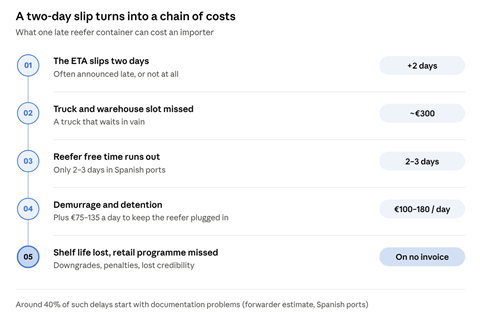
Free time for reefers is short. In Spanish ports such as Algeciras and Valencia, carriers typically allow two to three days, against five to seven for a dry container. After that, demurrage and detention on a reefer typically run at around €100-180 a day and rise after the first week. On top of that, the container must stay plugged in, usually billed from the first day at the terminal at roughly €75-135 a day.
Based on her experience handling these shipments, Meritxell Souto, who spent years at a forwarder in Algeciras, estimates that roughly 40 per cent of delays come from documentation problems, 45 per cent from transport problems at destination and 15% from port capacity. Most of the cost doesn’t come from the sea leg, but from information arriving late, a missing certificate or a truck booked for the wrong day.
A truck that waits in vain costs around €300, depending on the haulier and how early it is warned. Fruit that loses two days of shelf-life may be downgraded, discounted or rejected. When a claim follows, it is often hard to establish when the delay started and who knew about it.
The biggest cost may not appear on any invoice. Importers plan around retailers’ sales programmes. When a container is late, they miss those programmes, lose credibility with their customer, and can face penalties.
Then there is the time cost: the hours logistics teams spend every day checking carrier portals, reading emails and updating spreadsheets, just to know where their containers are.
Turning principles into measurements
The charter sets out five principles: collaboration and communication, fair and transparent business terms, competition and efficiency, cargo integrity and product quality, and resilience and risk preparedness. It is voluntary and deliberately broad, and the coalition has been clear it isn’t about one player against another. The figures above back that up: most of the cost comes from the hand-offs between parties, not from any single on of them.
What the charter doesn’t yet say is how anyone would know whether those principles are being met. Take ‘fair and transparent business terms’. A good place to start would be shared words: the same charge can appear as holding charges, demurrage or berthing fees, depending on who sends the invoice. Common terms, and a common way of measuring reliability for perishables, would mean importers, forwarders and carriers argue about the same facts.
Lane-level reliability data could become part of routing and carrier decisions, alongside price and transit time. It would give importers evidence when they negotiate free time or service terms, or support a claim. Over time, it would reward the carriers and ports that perform well for perishables, which is hard to see from the outside today.
Most of the data for this already exists. Importers know what they were promised, and carriers, terminals and forwarders already record what actually happened. If the coalition chose to measure reliability, what it would need from each importer is narrow: a container number, with its promised departure and arrival dates. No prices, no products, no buyers.
I understand the reluctance to share anything that touches suppliers and volumes. But in return, importers would see how their lanes and carriers compare with the wider market, and they’d have something solid to bring to the next free-time negotiation.
To earn importers’ trust, no one should be able to see an individual importer’s shipments. Results would only be published as combined figures, such as averages per lane or per carrier across many companies, so no number can be traced back to you. The method should also be agreed and public, and the metrics should reflect how perishables are planned, not only how ships run.
Importers don’t need to wait for the charter to start measuring. Track, per lane and per carrier, how far arrivals drift from the ETA you were planning with, and how many days before arrival your documents are complete. A spreadsheet is enough to start.
Ask your forwarders and carriers for the history of ETA changes, not just the latest estimate. And give the coalition your feedback on the charter through its website: the definitions set now will shape what ‘reliable’ means for years.
The charter gives fresh produce a shared set of principles. The next step is deciding how to tell whether they are being kept. Importers should help shape that, so that ‘reliable’ ends up meaning they could plan in time, not that the ship was on schedule.
Edouard Brière is the founder of Trackberry, a container tracking and document automation platform for fresh produce importers.