A warm winter delayed the colouring of mandarins and reduced lime flowering this year
Higher prices helped maintain the value of Peruvian citrus exports this year, despite reduced supply.
According to analysis by FreshFruit Peru, shipments between January and October – virtually the same as in the same period of last year, even though export volumes dipped 10 per cent to 307,103 tonnes.
Average prices rose from US$1.10/kg to US$1.23/kg, offsetting the shorter export crop. Mandarin exports, which account for 77 per cent of the total value, saw a 12 per cent drop in volume due to a warm winter that delayed fruit coloration in the regions of Ica, Lima, and La Libertad. Limes, by contrast, saw a 28 per cent increase in value, driven by production in Piura.
Forecasts for the full year point to a shipment value of US$393.5mn – less than 1 per cent more than in 2025 – with a volume of approximately 319,800 tonnes, heralding a 10 per cent decline on last year.
“This estimate assumes that late-season mandarins from Lima will continue to see higher shipment volumes than last year through the end of their season, and that the lime season will conclude earlier in December, as lime trees in the north bore less fruit during the winter,” FreshFruit Peru said, adding that this lower fruit set threatens to curb supply in the first quarter of 2027, when the lime harvest in Piura enters its peak season.
The consultancy noted that the 2023 Coastal El Niño was serving as a useful reference to the likely impact of this year’s weather phenomenon. That year, the total value of citrus exports remained relatively stable, even though volume for the January–October period fell by 4 per cent. A recovery followed the next year: in 2024, exports grew by 33 per cent in value and 20 per cent in volume, with 2025 proving to be the strongest year to date.
Regarding export destinations, the US remains Peru’s top market, accounting for 38 per cent of total value, despite an 8 per cent decline in its purchases. Mexico’s imports, meanwhile, grew 52 per cent, from US$52mn to US$79mn. The country now receives 21 per cent of Peruvian citrus exports. Shipments to Europe, fell by 19 per cent this year.
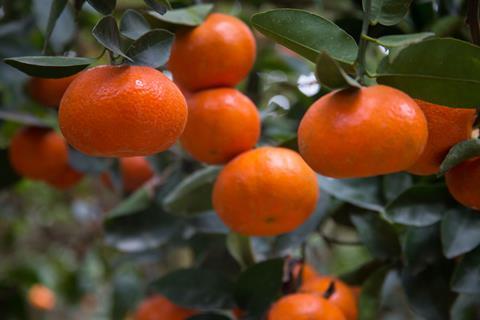
Between January and October, mandarin exports reached US$289.7mn and 222,779 tonnes – a decrease of 3 per cent and 12 per cent respectively compared to 2025. The price per unit rose 10 per cent to US$1.30/kg).
Ica accounts for 55 per cent of exports, followed by Lima (39 per cent) and La Libertad (5 per cent). Compared to 2025, Lima and La Libertad saw their shares decline (from 41 per cent and 7 per cent, respectively), while Ica’s share increased (from 51 per cent). A similar pattern occurred in 2023, which saw an 8 per cent drop in volume, with Lima being the most severely affected region.
According to FreshFruit Peru, the primary obstacle was colour. Mandarins reach internal maturity – achieving the proper balance of sweetness and acidity – before their peel transitions from green to orange. This colour change requires cold nights, which trigger the degradation of chlorophyll in the peel.
Industry association ProCitrus estimated that 40-50 per cent of the fruit remained within the domestic market. In this case, the US accounted for 43 per cent of the total value, while Mexico’s share rose from 17 per cent to 27 per cent, while shipments to the Netherlands fell from 9 per cent to 6 per cent.
Exports of limes – including both Persian limes and Key limes – reached US$65.6mn and 55,194 tonnes between January and October. This represents an increase of 28 per cent in value and 12 per cent in volume, with a price of US$1.19/kg (+14 per cent). This crop is the most geographically concentrated citrus in the country: for every 10kg exported, 9kg originate from the northern coast – 55 per cent from Piura and 38 per cent from Lambayeque.
Furthermore, Piura accounts for 63 per cent of national production, meaning that developments in its orchards almost immediately impact both the domestic supply and the volume available for export.
“To understand what lies ahead, it is helpful to look at how the lime tree grows,” FreshFruit Peru said. “The Persian lime produces multiple harvests per year, but its primary yield depends on cooler months; cold nights and a period of reduced irrigation prompt the tree to slow leaf growth and develop flower buds, which mature into harvestable fruit four to five months later.
The Netherlands became the top destination for Peruvian limes, accounting for 23 per cent of the total value of shipments – ahead of the US on 22 per cent and Chile 19 per cent – while the Dominican Republic doubled its share to 10 per cent.
Between January and October, orange exports reached US$10.9mn and 18,277 tonnes, representing a decline of 34 per cent and 38 per cent respectively. The Dominican Republic is the primary destination for Peruvian oranges, accounting for 38 per cent of the total value (up from 22 per cent in 2025), followed by the Netherlands (19 per cent) and the UK (12 per cent).