Projects will help growers reduce fertiliser use and improve sustainability
Industry body British Apples & Pears (BAPL) has secured £200,000 in funding for two new applied research projects through the ADOPT programme.
The cash will help strengthen the organisation’s grower-led research and development work aimed at improving sustainability, resilience and productivity in all commercial UK apple orchards, BAPL said.
It added that the funding from Innovate UK provides a significant boost to the research programme already supported by British apple and pear growers through BAPL’s voluntary levy, allowing the organisation to expand the scope of its work and accelerate delivery of practical solutions for the sector.
Novel fertiliser use in apple orchards and progress towards net zero
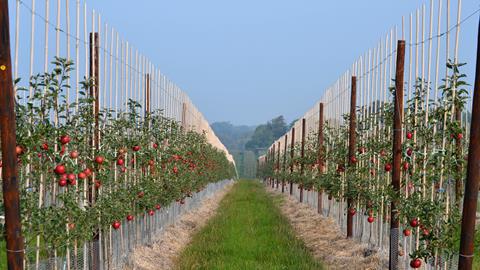
The first project will test whether innovative nitrogen technologies can reduce – or potentially replace – conventional foliar fertiliser applications in commercial apple orchards, without compromising yield or fruit quality. The aim is to help growers do more with less, cutting costs and emissions while maintaining orchard performance.
Running for 24 months from November 2025, the project will take place in two commercial apple orchards in England and will be delivered under real farm conditions to ensure results are directly relevant to growers.
The trial will evaluate two novel approaches to nitrogen nutrition:
- R-Leaf, a daylight-activated foliar spray that captures nitrogen pollutants from the air and converts them into plant-available nitrate directly on the leaf surface;
- Vixeran, a microbial biostimulant that supports natural nitrogen fixation in the root zone, helping trees access nitrogen already present in the soil environment.
The products will be tested both individually and in combination, as partial or full replacements for conventional foliar nitrogen feeds.
Working with scientific oversight from Niab, the project will measure tree nutrition, yield, fruit quality, storage performance and greenhouse gas impacts. The goal is to give growers clear, practical evidence on whether synthetic nitrogen inputs – and their associated costs and emissions – can be reduced while still delivering strong orchard performance and progress towards net zero.
Soil amendments to improve apple establishment
The second ADOPT-funded project will test whether soil amendments applied at planting can help new apple orchards establish faster, improve resilience, and reduce the carbon footprint of replanting.
The aim is to shorten the time it takes orchards to reach full production, reduce tree losses, and improve long-term soil health, helping growers achieve quicker returns from new plantings. The trial will evaluate the use of charged biochar, arbuscular mycorrhizal fungi (AMF) and Trichoderma, applied individually and in combination at planting.
These amendments have each shown promise in earlier trials, BAPL noted, and the project will test their performance together at commercial scale.
The goal is to reduce the time it takes new orchards to reach full production, cut tree losses, improve soil health, and create a circular, net-zero solution by turning end-of-life apple trees into stable carbon returned to the soil.
Led by AC Hulme & Sons, the project brings together a strong consortium of partners, including Ian Overy Farms as a second host grower, Niab providing independent trial design and scientific analysis, and Skylark Carbon supplying and charging biochar made from grubbed apple trees. BAPL will be overseeing the project and leading grower communication and knowledge exchange.
Working under real farm conditions, the project will measure early tree growth, survival, yield, soil structure and economics, providing growers with clear, practical evidence on whether these approaches can deliver faster returns from new orchards.
The project builds on an earlier Innovate UK-funded project that explored the feasibility of biochar as a net-zero solution for orchard wood at the end of orchard life.
“To secure not one, but two Innovate UK grants for this valuable research is fantastic news,” said Ali Capper, executive chair of BAPL. “This significantly amplifies the scope of our work and brings real tangible benefits to growers, with evidence-based insights on how growers can reduce conventional fertiliser use and use new soil amendments to improve orchard performance and sustainability. The projects are vitally important for the continued growth of our sector.”