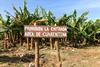
Agricultural scientist Professor James Dale considers why gene editing may be the only sensible option to develop a new banana variety with effective disease resistance

It has become very obvious that we will need to replace the current supermarket Cavendish sooner rather than later. So where might a Cavendish replacement come from? Conventional breeding gives us one comfortable option, with the advantage of having no technology-specific regulations governing the development and release of new varieties.
The conventionally bred Cavendish replacement will take 10 years to be ready for export in volume. It will be different to today’s Cavendish, but how different we don’t know. It will likely be resistant to both Panama Disease and Black Sigatoka. There may be three or four Cavendish replacement varieties coming from different breeding programmes. As with Cavendish, these will be ‘dead-end’ varieties as they will be sterile and therefore unsuitable for use as parents for future varieties.
What we can confidently predict is that in the future, there will be new diseases and other new challenges for bananas. The fungus that will cause ‘Panama Disease tropical race 5’ is likely out there somewhere already, waiting for humans to start moving it around the world. And the fungus causing Black Sigatoka will continue to evolve and probably overcome the resistances in the new Cavendish replacements in time.
When this starts having an impact, conventional breeders will have to go back to the drawing board and invest another 10 years or so of research into the next replacement, assuming resistance genes for these new disease variants can be found.
Even worse, the ‘Covid-19 of bananas’ could arrive. This hypothetical disease crosses the species barrier; its natural host is a wild plant or maybe a domesticated crop totally unrelated to bananas. It may already be infecting bananas somewhere in Asia, and there is unlikely to be any resistance in bananas globally.
Will we then start to consider, and accept, the more controversial technologies that will provide our supermarkets, year-round, with inexpensive fruit produced with minimal or no pesticides? These are the technologies that will allow us to move only genes rather than whole genomes from one banana to another, or from other plants to bananas, or maybe even insert synthetic genes, all without disturbing the essence of the original variety. I think we will. In fact, I think we must, though synthetic genes may be too far a leap to consider in the foreseeable future.
So, ultimately, we will have a catalogue of genes to mobilise for banana improvement: genes from other bananas or from other plants that have enhanced function, such as better resistance. It could be a gene that protects bananas against frost or extreme temperatures, or a gene which can withstand flooding or destructive storm damage. However, most of this catalogue will just gather dust if we restrict ourselves to conventional breeding.
Edited extract from The Future of Bananas by James Dale, out now from Melville House UK.
In the book, the Australian agricultural scientist traces the history of the banana to understand why it is such an important fruit, why its future is under threat, and why the western world is obsessed with one variety: the Cavendish.
Using the latest cutting-edge research and technology, Dale’s book presents a vision for saving the world’s most eaten fruit, which is on the path to extinction. The author and his team at the Queensland University of Technology have in fact created the world’s first genetically modified banana approved for commercial production, called QCAV-4. Could this be the future? And what else might be in store?