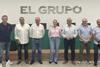
Kent arable farmer and horticulture spokesperson Kevin Attwood succeeds Dr Oliver Doubleday, who steps down after eight years in the role

Dr Oliver Doubleday, who has served as chair of horticultural research charity the East Malling Trust (EMT) for eight years, has stepped down from his position.
He has been succeeded as chair by Kevin Attwood, a prominent Kent arable farmer and influential spokesperson for horticulture.
Dr Doubleday, whose involvement in horticultural research spans nearly four decades, is stepping down after helping guide the charity through a period of development.
Based at Bradbourne house in Kent, the charitable trust promotes the advancement of research, innovation and education in horticulture and food, for public benefit.
Dr Doubleday trained as a molecular biologist and ran his family’s mixed estate business GHD & Co Limited for many years.
He first became involved in the sector’s research in 1990 as vice chair of the Apple and Pear Research Council under Sir Colin Spedding.
Later he moved to chair East Malling Research (EMR) upon the retirement of Hugh Lowe, before being appointed as EMT chair in 2018, succeeding Professor John Mumford of Imperial College.
Dr Doubleday said: “The best bit about my time at EMR and EMT was the fantastic variety of different people you got to work with, exploring ideas on how to promote the importance of horticulture in the UK.”
Karyn Hood, CEO of the EMT, praised his contribution to the charity: “Oliver has been a fantastic ambassador for horticulture and a massive driver in our evolution as a charity.
“His deep understanding and knowledge of the sector and the role research plays has boosted the trust’s profile,” she continued. “During his stewardship, the board has secured fresh funding fundamental to our development and in ensuring we play a critical role in supporting the UK’s future food security.”
Calls for greater research investment
As he stepped down, Dr Doubleday called for stronger regional and national support for horticultural research, arguing that greater collaboration will be essential to delivering future breakthroughs.
Horticulural research has an increasingly important role in answering some of the UK’s biggest societal challenges, including food security, climate change and a health diet, he said.
He also added that a more coordinated approach could help improve the competitiveness of the UK fresh produce sector while contributing to the UN’s sustainability goals.
“The fragmented nature of horticulture has never delivered the profile it deserves, and this has made securing funding for vital research a difficult task - this needs to change,” he said.
“I’m now confident that The East Malling Trust has the foundations in place that can overcome some of the fragmentation. When you combine this with closer scrutiny on sovereign food security and climate change, we are in a strong position to lead the conversation on research going forward.”
EMT’s historical research has contributed to advances in fresh produce storage, sustainable crop protection and waste reduction.
The leadership announcement comes as the trust prepares to host its Horticulture and Healthy Diets Conference, today Monday 26 October.
The event, which will welcome growers, researchers, businesses, specialists and policymakers to The Orchards Conference Centre at EMT, will feature keynote addresses from David Dimbleby and Professor Martin Warren.