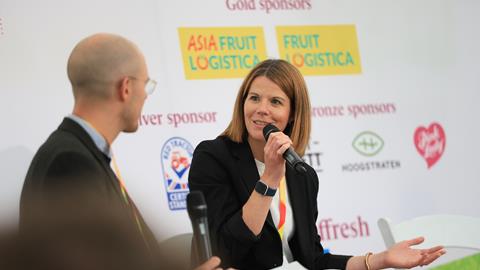
Category director Hannah O’Reilly tells Festival of Fresh how retailer values long-term working
Partnerships with suppliers are at the centre of Sainsbury’s strategy as the supermarket looks to navigate a difficult macro environment to offer consistently high-quality fresh produce and inspire consumers to eat more healthily.
That was the key message put forward by the supermarket’s fresh produce category director Hannah O’Reilly, in conversation with FPJ editor Fred Searle at the Festival of Fresh on 10 June.
In March, Sainsbury’s expanded its long-term partnership model to 62 British berry farms, agreeing new five-year contracts with Angus Soft Fruits, Chambers, Soft Fruits Direct, J.O. Sims and Dyson Farming. The retailer said at the time that the move marked a significant extension of its long-term agreements, and O’Reilly emphasised it was a “very public and important pillar of our strategy as a business.”
“That stems from a very genuine belief that the only businesses that will win in this industry are those that have the very best relationships that work hand in hand with their supply chain, and focus on the progressive solving of the long-term problems that we’re all facing together,” she said.
Taking a long-term approach
Noting that Sainsbury’s launched its Dairy Development Group back in 2007, O’Reilly pointed out that the supermarket now has long-term relationships across beef, pork, chicken, eggs, berries and some root veg. “We’re very hopeful of announcing a few more in the not too distant future,” she added.
O’Reilly said the commitment to partnerships is “the key thing we are doing”, pointing out that chief executive Simon Roberts wants to bring stability and the confidence for farmers to plan and invest. That in turn means top-quality food for Sainsbury’s shelves and British consumers.
“A lot of these partnerships are underpinned by very transparent cost-of-production models,” she continued. “That enables us to support those conversations in a really pragmatic way. We’re effectively running a business jointly together for its success, as opposed to a kind of win-lose negotiation-style relationship.”
Mitigating risk
Strong partnerships is just one part of what Sainsbury’s is doing to ensure resilience and reduce risk, O’Reilly said, explaining that the retailer’s agriculture team carries out its own research about what risks are on the horizon to ensure it can prepare long-term mitigation plans. “Then it’s about working in a very practical way in the nearer term, where we see risks coming and we know we’ve got a period of volatility coming [to see] again how we work hand in hand with our partners to put in place those mitigation plans,” she said.
The health challenge
O’Reilly was also keen to highlight Sainsbury’s ambition to grow consumption of fresh produce and address the longstanding obesity crisis in the UK. That includes getting thousands of tonnes more fibre consumed in the national diet, and millions more portions of fruit and vegetables by 2030.
“It’s the engine of growth,” she said. “If we can get the nation eating more fruit and veg, they become healthier and more productive. Food and the food system could quite possibly be the catalyst for that growth that we’re craving so desperately as a nation. So we’ve got this real health imperative and that’s why we want to drive that consumption.”
There are barriers, however, one of which is the need to inspire consumers in the art of cooking. Current innovation is heavily focused on finding convenient, healthy solutions for time-pressured customers, while there is also growth in the premium and healthy snacking spaces.
In the case of the former, there’s opportunity for fresh produce in high-quality home meals where consumers are replacing eating out with inspirational dishes at home.