Industry makes inroads into markets across the region, driven by advances in varieties, quality and marketing

The 2025/26 season marks a defining moment for the Chinese blueberry industry. As production capacity continues to surge, leading exporters are expanding their international footprint.
In terms of sheer volume, China’s presence in the global blueberry market is now impossible to ignore.
“Currently, China’s blueberry planting area ranks first in the world, but at this stage, the majority of production is used to satisfy the massive domestic market; exports are more a result of production overspill,” says Dani Geng, blueberry category director at Joy Wing Mau Group (JWM).
Sebastian Deng, partner at Pengsheng, observes that while the industry still faces gaps in export standardisation and post-harvest handling, the pace of development is extraordinary.
“It is predicted that within the next three to five years, China will become the world’s second-largest blueberry exporter,” he notes.
Pengsheng leverages its extensive years of experience in the fruit import trade to fuel this expansion. The company is focusing its exports on Thailand, Hong Kong, and Singapore, while exploring new frontiers in Russia and Central Asia.
“Our export growth is fundamentally in line with expectations, yet the potential remains vast,” says Deng. “By collaborating with existing export partners, we are securing market space for Chinese blueberries outside the supply window of Peruvian blueberries.”
Localisation strategies
Joyvio Blueberry, JWM’s premium blueberry brand, has successfully cultivated trust abroad through consistent high-end positioning, according to Geng. He identifies JWM’s deep-rooted localised service capability in South-East Asia as its primary competitive advantage.
“We have an experienced local team capable of providing full-chain services from customs clearance to shelf placement,” he explains.
“Furthermore, we have a deep understanding of the consumption habits, festival cultures, and dietary preferences of various South-East Asian countries. Through long-term strategic partnerships with local mainstream high-end supermarkets, we help domestic blueberries achieve rapid market entry and secure premium shelf space.”

On a product level, the group tailors varieties, packaging, and marketing strategies to specific markets – matching fruit size, durability, and shelf-life to diverse consumer scenarios, he explains. This systematic approach involves distilling domestic operational successes, adapting them to local conditions, and funnelling consumer feedback back to growers to create a continuous optimisation loop.
“Global sales of Joyvio blueberries have now surpassed 400mn boxes, successfully allowing overseas consumers to gradually establish quality trust and brand recognition for ‘premium Chinese berries,’” Geng says.
Changing buyer perceptions
The perception of Chinese fruit among South-East Asian buyers is evolving alongside varietal updates, according to Geng. He says JWM is opening up significant market potential through a diversified and legally protected portfolio of superior varieties.
“We continue to introduce world-leading blueberry varieties. Currently, JWM is the only Asian member of Sekoya and a tier-one member of MBO,” he notes. “These two varietal programmes, after years of global selection and breeding, possess significant advantages in firmness, Brix-acid ratio, and flavour profiles. Relying on legal variety licensing and localised planting, we can build a competitive barrier in quality stability and supply continuity.”
However, while high-end varieties lead the charge, the industry still faces the “growing pains” of quality perception and cost manoeuvring in conventional channels. Deng points out that many overseas buyers still view Chinese blueberries primarily through the lens of price advantage and as a supply supplement.
“While top-tier Chinese blueberries often exceed market requirements, conventional channels remain accustomed to older standards and are highly price-sensitive,” Deng explains. “To remain competitive, some exporters ship lower-quality fruit. Additionally, because many Yunnan growers lack commercial scale, inconsistent harvesting and post-harvest handling have created a subjective impression among overseas consumers that Chinese quality is unstable.
Supply windows open up
Despite this, geopolitical shifts and climate-related supply disruptions in the Middle East and Africa have created a unique window of opportunity.
“This supply vacuum allows Chinese exports to grow rapidly, and I believe we will gradually achieve full coverage of the mid-to-high-end segments in the future,” Deng says.
Geopolitics serves as a “double-edged sword”, on one hand breaking existing supply patterns to create entry windows for Chinese blueberries, and on the other hand, placing higher demands on supply chain resilience.
Deng points out that from the perspective of long-term competitiveness and quality stability, seafreight cold chains are currently the optimal choice.
“Currently, seafreight cold chains perform better in temperature control, ensuring more stable quality upon arrival, whereas the cold chain protection for airfreight is not always complete in certain segments,” he notes. “Land transport depends largely on road conditions, and the stability of rail transport for fresh produce currently lacks consistency. Therefore, seafreight remains the choice with the most comprehensive advantages, especially as cost efficiency and competitiveness will become more prominent once overall volumes stabilise.”
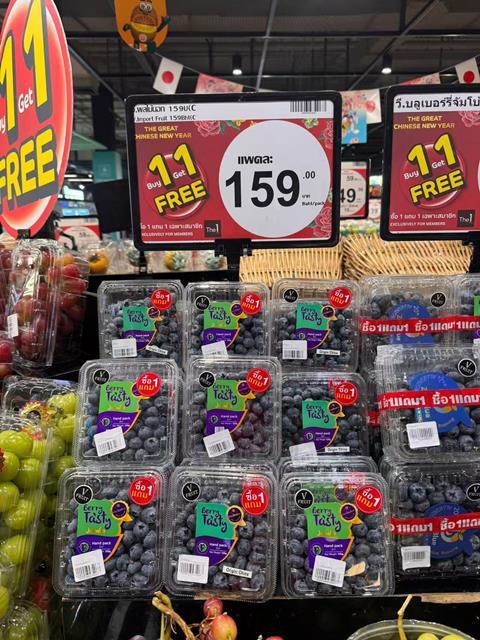
Geng states that JWM flexibly combines airfreight and seafreight based on market demand, variety characteristics, and cost structures.
“The advantage of airfreight lies in speed; blueberries can be delivered from China to South-East Asian retail shelves in three days, ensuring extreme freshness. Meanwhile, seafreight reduces costs through large-scale cold chains, increasing market penetration,” he explains.
“Overall, it is necessary to flexibly schedule both methods to achieve the optimal balance of efficiency and cost.”
Pairing with South American supply
For a long time, South American suppliers like Peru and Chile have focused on export-oriented models, forming mature multinational supply chains. However, the growth of Chinese blueberries is not merely a zero-sum shift in the global market, but rather a significant strategic complement.
“South American blueberry supply occurs during the Northern Hemisphere’s autumn and winter, while Chinese blueberries primarily supply the spring and summer. Therefore, the two are not in competition but are complementary,” Geng says.
“As Chinese blueberries continue to upgrade across supply chain segments such as varietal improvement, post-harvest handling, and cold chain logistics, we are very confident in securing a significant position in future global blueberry trade.”