Fresh produce industry leaders gather in Hong Kong, discussing key trends including resilient demand, a bifurcating market, and the rise of quick commerce
The International Fresh Produce Association (IFPA) held its Executive Leadership Summit Asia on 1 September, bringing together more than 160 executive leaders from across the global supply chain.
IFPA CEO Cathy Burns said the event was a place to “learn together” rather than be talked at from the stage, and it also marked the debut of IFPA’s new Asia Council.
“If there’s a challenge that’s happening across the globe, we can bring the whole supply chain together to talk about potential solutions,” Burns said, highlighting the value of working together and organisations like IFPA. She also reminded the role the industry plays as one of the few capable of changing the trajectory of human health.
“You cannot be healthy without eating fruits and vegetables. Full stop,” she said.
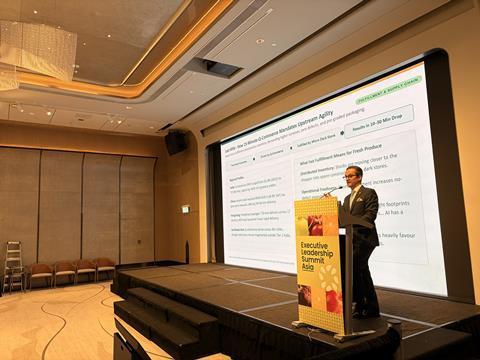
The anchor of the day was a data-dense keynote from Patrick Vizzone, IFPA’s board chair and founder of AgroNovare Holdings. He noted three key trends currently influencing the fresh produce landscape.
Vizzone said fresh produce was a resilient category and revealed that across Asia, produce spending is proving inelastic even under inflationary pressure, with consumers cutting packaged and ultra-processed foods before they trim fresh. In China, Vizzone noted, only about 5 per cent of consumers say they would reduce fresh produce spending if prices rose. In Japan, only 8 per cent would trim fresh, while more than 35 per cent of those respondents reported they are actively cutting packaged snacks and prepared meals.
Vizzone said fresh produce volume is rising and prices are falling in the commodity mass market, squeezing margins, even as a premium tier defined by quality, provenance, and high-Brix fruit commands real pricing power. Vizzone pointed to durian — now a US$7.5bn import category into China — as the emblem of provenance-led value.
Thirdly, Vizzone said the last mile was compressing. Quick commerce is the story of the next three to five years, he argued, with penetration already around 82 per cent in India and 83 per cent in China, against 34 per cent in Europe and just 3 per cent in North America. That shift pushes stock closer to the shopper in space-constrained micro-stores, raising the stakes on forecasting, shrink, and defect tolerance — challenges for a category that doesn’t make “widgets.”
Vizzone was equally blunt about geopolitics, offering a simple formula — free-trade agreements, plus sanitary and phytosanitary access, plus geopolitical alignment, plus cold chain, equals realised trade flow.
He issued wry warning about what he dubbed “Drosophila politicus,” the “political fruit fly” that seems to appear at the border whenever supplies are up and prices are down. His counsel to exporters: diversify across markets, and remember that in trade, you “praise in public and criticise in private.”
His crystal ball for the region pointed to continued Asian demand growth, deepening bifurcation, AI moving “from electrons to atoms” through physical automation, and climate quietly redrawing the map of where produce can be grown.
Iván Marambio, president of Frutas de Chile talked about some of the risks facing the fresh produce trade in an era when “a regulatory concern can become a trade disruption, and a trade disruption can become a media story, and a media story can become a reputational challenge — all within days, sometimes within hours”.
Consumers, he noted, do not distinguish between commodities or countries of origin; they see “fresh produce”. That means trust, and risk, travel together.
Drawing on Chile’s own experience managing cherry-reputation issues in China, Marambio made the case that reputation is not merely a communications concern but a market-access asset — one that determines whether regulators, retailers, and media give a company the time to explain when something goes wrong. He argued for shared capacity across the industry’s existing networks to detect emerging risks sooner, verify information faster, and coordinate more effectively.

The day’s closing panel, moderated by Burns, turned to sustainability. Dean Gall of Premier Fresh Australia, Elena Hernandez of Sun World International, and Ninjacart’s Sharath Loganathan examined the idea that consumers say they want sustainability but rarely pay for it.
For Loganathan, sustainability only endures when it lives in the operating rhythm of the business – tracked as food waste per kilogram, reviewed monthly, and paid back inside an operating cycle.
Hernandez located Sun World’s advantage upstream, in breeding varieties that deliver value “all the way through” – for the grower, the supply chain, and, ultimately, a consumer who will buy again.
Gall emphasised measurement and baselines as the starting point for any credible sustainability claim and pointed to Asia’s mastery of premiumisation as something more commoditised markets can learn from.
Running through the exchange was a shared conviction, voiced repeatedly by Burns: the single most powerful thing the industry can do for the planet and for its own growth is to drive consumption – and to tell its story, in her words, “unapologetically”.


