Fresh Produce India hears how health awareness and new marketing channels are shifting market towards higher-value fruit and veg
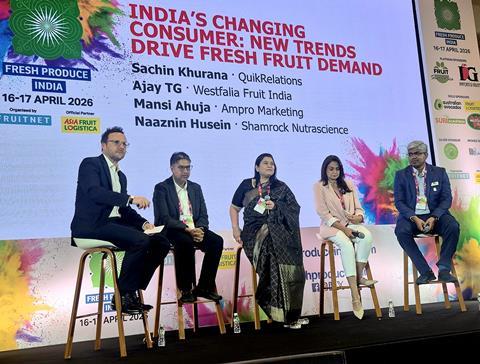
The lightning speed at which consumer habits are changing in India is creating new opportunities for fresh produce suppliers, with the health and wellbeing trend, emergence of quick commerce platforms and thriving horeca channel fuelling demand for high quality fruits and vegetables.
The opening session of this year’s Fresh Produce India, which took place on Thursday in Mumbai, painted an upbeat picture of the outlook for India’s fresh produce industry in the years ahead. Demand for premium produce is booming as consumers become more discerning, and the market is wide open for suppliers who can satisfy their craving for new experiences.
According to Sachin Khurana of agribusiness marketing specialist QuikRelations, India is no longer a market driven primarily by price. “We are transitioning from a price-conscious market to a value-conscious market, where people are seeking a balance between price and quality,” he said, noting that “consumers are prepared to pay more for freshness, taste and safety”.
Perhaps the biggest driver of fruit and vegetable sales is the health and nutrition trend. Social media provides instant access to advice from doctors and nutritionists at the click of a mouse, while initiatives like the Eat Right campaign, which has been running for several years, have raised awareness of the importance of healthy eating, using simple messaging to translate complex science into accessible advice on how to make diets healthier.
As a result, said Mansi Ahuja of Ampro Marketing, consumers are no longer asking for tasty food, but food that is good for them. “They want to know what the functional benefits of specific products are and as marketers, we need to find ways to respond,” she said, highlighting the need to provide more relatable information. “Consumers want to know that a fruit will trim their waistline or give them glowing skin.”
Ajay TG of Westfalia Fruit India claimed both generic campaigns and brands have a role to play in consumer messaging. Speaking of his experience in avocados, he said generic promotions by organisations like the World Avocado Organisation have a crucial role to play in teaching consumers how to eat the product and what its health benefits are.
“The next step is about giving them the confidence to know that the avocado they are buying is a good one, so that they can be guaranteed a consistent experience. That’s where the brands come in,” he said.
Much of the session was given over to discussion on the potential of the quick commerce channel to drive demand, particularly for premium products. According to Ajay TG, it has proven to be an effective vehicle for growth in avocado consumption, allowing Westfalia to target consumers in a very specific way. Highlighting the meteoric growth In the ripe and ready avocado segment, he said this now accounted for 50-60 per cent of the company’s sales volume in quick commerce.
Khurana said the channel allows companies to take the consumer on a journey of discovery. “Quick commerce has been the catalyst for premiumisation: It satisfies cravings and some of those cravings then become habits,” he pointed out.
Asked about the long-term sustainability of quick channel platforms, Khurana said the objective now was to provide a proof of concept, predicting that it would take several years before the model had a chance to become profitable. In the meantime, it was noted that one of the positive impacts of the growth of this channel was an acceleration in investment in the cold chain.
Horeca was identified as another huge opportunity to drive sales of premium produce. Ahuja said Australian Avocados regularly works with chefs to create menus that consumers are then inspired to try out at home.
The morning sessions concluded with a discussion exploring what it takes to build a fresh produce brand in India. Speakers agreed that there is plenty of room to develop this part of the business, with several categories – currently such as pears and mandarins – lacking successful brands.
Rajoo Ramlingha of food retailer Star said a brand needs to add value through differentiation; provide consistency in terms of quality and taste; and be done right year after year in order to build an established following. Education, targeted consumer research, in-store sampling and story-telling were all highlighted as essential elements behind the creation of a successful brand.
With consumers – particularly younger ones – becoming more experimental, Varun Kakar of Four Pillars Australia observed that there was a real opportunity to build new brands that reflect India’s growing awareness of health and wellbeing.
“India has huge potential – provided you treat it well,” Khurana summarised. “The market evolving rapidly, with new consumers emerging every day. It’s up to us to drive that growth forward and allow Indians to eat better.”