The global banana sector faces a plethora of challenges, but industry experts insist the fruit’s future can be made secure by appropriate measures
Since the extinction of the banana has been a popular story in the media for more than two decades, there is a danger that many people now treat the notion with a fair amount of skepticism.
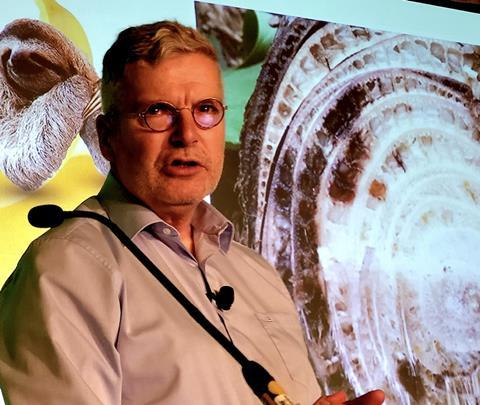
For Gert Kema, board member of Yelloway and emeritus professor of phytopathology at Wageningen University, and Andrew Dominy, vice president of product management at Tropic Biosciences, the need to balance reassurance with urgency is clear.
“We shouldn’t dramatise the situation,” said Kema. “We’re not running out of bananas in the supermarket. But if you look at previous fusarium wilt epidemics, you see the severity and significance of these diseases, and it is absolutely serious.”
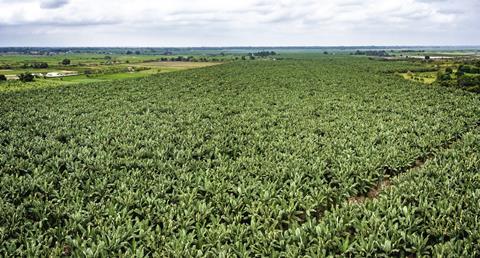
At the centre of concern is Tropical Race 4 (TR4), a strain of fusarium wilt that attacks the Cavendish variety, which dominates global exports. While Cavendish once saved the entire industry thanks to its resistance to earlier strains, it is highly vulnerable to TR4 and also susceptible to Black Sigatoka, increasing reliance on fungicides.
“The number of fungicide applications over time is just increasing,” Kema noted. “And banana cultivation is one of the very few huge monocultures. That in itself is already an immense risk.”
The spread of TR4 has already had a profound impact in Asia and is now a growing concern in Latin America, the most important exporting region for the US and European markets.
“TR4 started in Asia and slowly moved its way around the world,” said Dominy. “Just this last year it was confirmed in Ecuador.”
The consequences in Asia have been stark. “In the Philippines, which had over 100,000ha of production, we’re now at around 86,000ha,” he explained. “Growers are reducing production because they don’t have access to disease-free land.”
The disease is also changing the structure of the industry. “What was a dominance of small-scale growers has shifted towards larger companies that are able to afford the treatments and quarantine measures,” said Dominy. “Smallholders have lost out in those situations.”
In Latin America, the spread has been slower, but the risks are clear. “It is the most important production area for Europe and the US,” he said. “There is a lot of concern and a lot that needs to be done to keep the disease contained.”
Kema agreed that the situation in Ecuador is particularly significant. “The majority of growers in Ecuador are smallholders,” he said. “There are mobile crews going from one farm to another. That’s exactly how the disease spreads. Fusarium wilt doesn’t happen overnight. It may take a decade before you see a major impact on exports, but it will come.”
Innovation gathers pace
Against this backdrop, both Yelloway and Tropic Biosciences are working on solutions, albeit via different approaches.
Tropic BioSciences is using gene editing to develop disease-resistant bananas. “We’ve progressed quite far,” said Dominy. “We’ve completed greenhouse trials confirming resistance, and we now have gene-edited material in field trials in multiple countries.”
These trials are assessing not only disease resistance but also yield and agronomic performance. “It’s critical that growers can achieve at least the same production levels as today,” he said. “We’re expecting to have commercial plants in the market in the latter half of 2027.”
Yelloway, by contrast, is focused on “classical” breeding, according to Kema, but using the latest genetic technologies to speed up the breeding process. Its ambition goes beyond simply replacing Cavendish with a single alternative.
“We don’t want to maintain or improve Cavendish – we want to kick it out,” said Kema. “Our goal is to develop multiple genetically different, tasty, resistant varieties, like Yelloway One. Look at tomatoes – 20 years ago, there was just a small number of types. Now there’s huge diversity. That’s what we aim for in bananas.”
Such diversity would not only broaden consumer choice but also boost the sustainability of the category. “A monoculture is intrinsically risky,” Kema explained. “Diversity is key to sustainability.”
Beyond disease, climate change is adding further complexity to banana production and supply chains. “Bananas are affected by adverse weather conditions like any crop,” said Dominy. “We’re seeing changes in climatic stability that affect productivity, timing and crop cycles.”
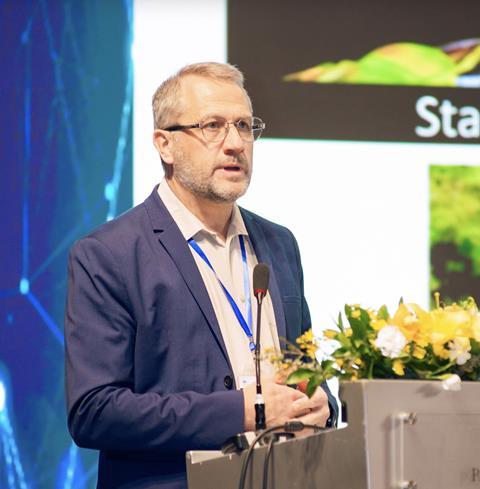
Inevitably, logistics are also under pressure at present. “It’s a very tight supply chain,” said Dominy. “One disruption can have a big impact on availability for consumers.”
At the same time, growers face mounting economic strain. “Bananas are almost the cheapest fruit on the market,” Dominy said. “Consumers don’t necessarily want to pay more, and that puts a lot of pressure on growers and makes it harder for them to maintain their livelihoods.”
Kema echoed that concern. “If you look at the labour that goes into producing a box and the share of the final price going to the producer, there is some imbalance,” he said. “It is frustrating. I still believe that the supermarkets could be very strong allies in truly contributing to sustainability.”
Consumer perceptions are also evolving, particularly around new technologies. Dominy believes gene editing is gaining acceptance, especially among younger shoppers.
“They are very supportive,” he said. “They want products that reduce environmental impact. We’ve already commercialised our non-browning banana, and there’s a lot of interest in that and the way it can evolve the market, and consumers are happy to try it and buy it on a continuous basis.”