Veg growers are showing how technologies can help boost sustainability, including cutting waste and fossil fuel use
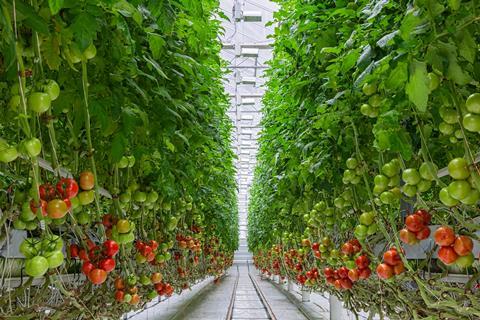
Greenhouse growers in Belgium are highlighting how technology can help meet their sustainability goals while coping better during heatwaves and other more frequent weather extremes.
“Solar panels that boost plant growth, near-zero plastic waste, reduced peat use, and a steady march away from fossil fuels are among their latest initiatives,” stated VLAM, the Flanders Agricultural Marketing Board, ahead of the participation of 21 Belgian exporters at next month’s Fruit Attraction in Madrid, Spain.
At Tomato Masters in Deinze, East Flanders, 32 colour-tinted solar panels filter sunlight to the tomato plants, allowing in the precise amount needed for photosynthesis while converting the rest – an average of 4.5 kW – into electricity.
“You could see the difference from a metre away,” said co-owner Tom Vlaemynck. “The plants under the panels are stronger and show less stress. They warm up less, transpire less water, and stay more vital during hot periods.”
And according to VLAM, this idea is spreading. “Elsewhere in the Tomeco network, solar panels float on a water basin, cutting evaporation and generating power at the same time,” it revealed. “Down the road, leek grower Jurgen De Roo has installed panels of his own to cover part of his farm’s electricity needs.”
Plastic is also disappearing from Belgian greenhouses. Under the Zero Waste project – a joint initiative of Inagro, Harvestis and Ghent University – growers are opting for biodegradable alternatives to nylon crop ropes and plastic clips. One advantage is that an entire crop cycle can go directly into the compost heap, with no need for sorting.
“A second project, ReduVeen – run by Harvestis and Inagro – is taking aim at peat, a resource widely considered unsustainable,” VLAM said. “With global demand set to double by 2050 and peat-free alternatives still covering barely 15 per cent of the market, researchers are working with growers to cut peat use in growing substrates by at least 35 per cent.”
But the organisation sees the most ambitious initiative as the reduction of fossil fuel use. Belgian pepper growers are significantly reducing gas consumption by installing not only solar panels but also high-insulation energy screens and advanced heat pumps.
“We have invested in cogeneration,” said one grower, Neyens. “Part of the electricity is used in the greenhouse; the balance is injected into the grid. The cooling water from the engine heats the greenhouse. The gases released during combustion are 100 per cent purified. The released CO2 is used as fertiliser for the bell peppers.”
Belgian fresh produce exports mainly go to other European markets and have largely remained stable over the last decade, aside from a notable increase of 163,340 tonnes between 2024 and 2025. VLAM attributed that recent increase to the sector’s focus on continuous improvement, freshness and quality.
“The Belgian horticultural sector is a global leader in innovation because our research centres build solutions based directly on what growers need on the ground,” said Nele Van Avermaet, VLAM’s promotion manager for fruit and vegetables. “Faced with climate volatility, our growers are making long-term investments to guarantee a reliable, sustainable supply for European supermarkets.”