Despite growing challenges of heat and drought, Belgian pear producers appreciate their fortune, as conditions worsen further south
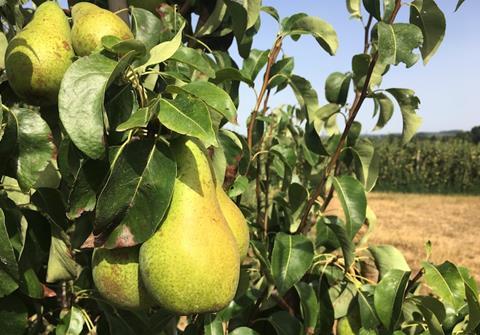
For pear growers across Europe, climate change represents both a present danger and a longer-term architect of future production in the region, as dry, scorching summers challenge current water reserves and gradually warmer winters deprive crops of the requisite chilling hours.
For Belgian pears, the fact that the impact on southern Europe is significantly worse than in the north is not insignificant.
Warmer winters don’t just mean warmer conditions for the tree, according to Laurent De Smedt of Belgian cooperative Belorta. “They can interfere with the physiological process that prepares it for spring,” he said. “Pear trees need a certain amount of chilling during dormancy before they can reliably resume growth and flowering in spring. Insufficient winter chilling can lead to irregular budbreak and flowering, reducing yield and uniformity.”
The gulf in productivity between Belgium and southern European producers like Portugal, Italy and Spain is already stark and expected to widen further, according to Marc Evrard of Belgian Fruit Valley. “Portugal has a similar production area to Belgium of around 10,000ha,” he said, “yet its annual volume of around 125,000 tonnes is dwarfed by Belgium’s more than 400,000 tonnes.”
De Smedt said higher summer temperatures were also accelerating ripening. “Pears turn yellow and mature much faster when the temperatures are high,” explained. “This summer we started picking early, in mid-August.”
Belgium experienced extreme heat ahead of this season’s harvest, with daytime temperatures reaching 35°C and more than 40°C in the sun, while night-time temperatures remained around 21-22°C. A sharp fall in temperatures just as harvesting began helped ameliorate conditions for pickers, as well as the quality of the fruit.
Despite good availability of water, the dry conditions have taken their toll on volumes, if not quality. “Most important is that we don’t have quality problems this year because of the warm weather, and the pears have a better pressure compared to last year,” revealed De Smedt. “There is a drop in the volume, but we hope prices will compensate for this.”
Asian market evolves
Outside of Europe, East Asia remains an important growth market for Truval-branded pears, even as changes there create new challenges.
Twenty years ago, according to Evrard, Belgian exporters entered China with Conference pears at a time when Chinese buyers were looking overseas for reliable, high-quality fruit. Today, he explained, domestic production has become far more established.
“Now consumers in China have much more confidence in domestically grown production,” Evrard revealed. “They know what we do is good, but there is much more confidence in local production and also much more control over locally grown food.”
However, one of Belgium’s biggest advantages is the limited geography in which Conference pears can be grown successfully. “Conference cannot be grown everywhere in the world,” said Evrard. “Many have tried. There is a relatively narrow production zone in northern Europe that is capable of producing good-quality Conference. That is a huge advantage.”
The greatest competition is in fact coming from other fruit categories, especially in Asia. Blueberries, avocados and durian are all gaining ground, while China has developed its own blueberry production to the extent that it has become a net exporter, Evrard noted.
The response from Belgian exporters has been to focus increasingly on the premium end of the market. Truval is a key part of the strategy in China, where De Smedt describes it as the benchmark pear brand. The aim is also to use the brand to build recognition for newer varieties, including Sweet Sensation, while distinguishing it from other red-blush pears such as QTee.
The strategy for these newer varieties is deliberately different from the original Conference approach. Rather than the large volumes of the Conference, the plan is for smaller, premium programmes. In China, Evrard sees 300-500 containers a year as a realistic niche. The next step, De Smedt said, is to develop similar programmes in markets such as Thailand and Vietnam. A week-long celebration of Belgian pears is apparently in store for Thailand later in the year, with Conference, Sweet Sensation and Fred being marketed together.