After losing its export crown to South Africa last year, will Spain’s citrus industry rally following the reactivation of Intercitrus?
Looking back at what’s happened over the last decade can provide valuable insight into what’s in store for the upcoming citrus season in Spain. First, let us examine the crop forecasts compiled by the Ministry of Agriculture over the last ten seasons.
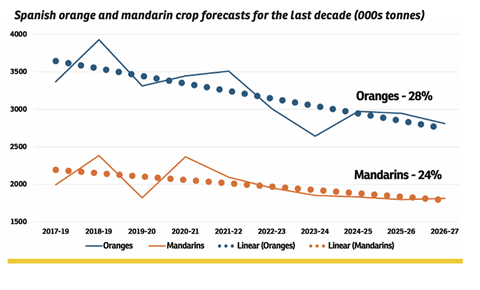
As you can see from chart 1, the trend is clear for both categories. In oranges, Spain has gone from having 149,000ha of production to 133,000ha in the past decade – a loss of 16,000ha or 11 per cent of total planted area. However, the pattern varies by production zone. The Valencian Community went from 73,775ha to 64,747ha, a loss of 9,028ha or 12 per cent of the total. Andalusia, meanwhile, went from 60,471ha to 57,161ha – a 5 per cent decrease equivalent to 3,310ha. And in Murcia, acreage has contracted by 28 per cent, falling from 11,284ha to 8,138ha.
For mandarins, the overall planted area has fallen from 110,000ha in 2017/18 to 91,400ha in 2026/27. That is a loss of 18,600ha or 17 per cent of total planted area. Again, the picture varies considerably depending on the region. The northern zone (Valencian Community plus Tarragona) went from 86,851ha to 63,960ha, a loss of 22,891ha or 26 per cent of the total. Andalusia and Murcia are moving in a different direction however. Andalusia had 16,537ha of mandarin production in 2017/18 and now has 20,106ha, representing an increase of 3,569ha or 22 per cent. Following the same trend but at a lower absolute level, Murcia had 6,664ha of mandarins and now has 7,257ha; an increase of 593ha or 9 per cent.
Across the board – combining oranges and mandarins – the Northern zone (comprising the Valencian Community and Tarragona) has lost 31,010ha of production, representing a 20 per cent decline over ten years. In my view, the primary reason for this loss lies in the structure of citrus production in the area; it was overwhelmingly based on smallholdings – mostly farms that were not only small but also fragmented into isolated plots, often averaging just 0.4ha. The rate at which these plots are being abandoned is exponential, constituting the main structural challenge facing the citrus industry in the Valencian Community.
In contrast, Andalusia has maintained its total orange and mandarin acreage at 77,000ha, as the decline in orange cultivation has been offset by an increase in mandarin production. As for Murcia, the area dedicated to oranges and mandarins fell from 17,948ha to 15,395ha; however, this reduction occurred even as growth in lemon and grapefruit production was being absorbed and surpassed.
In both Andalusia and Murcia, farm sizes are significantly larger than in the Valencian Community – a factor I consider the main reason for the disparity between these regions. It is clear, however, the growth seen in Andalusia and Murcia cannot compensate for the losses in Valencia.
Consequently, we have seen a decline in orange and mandarin exports over the last ten seasons.
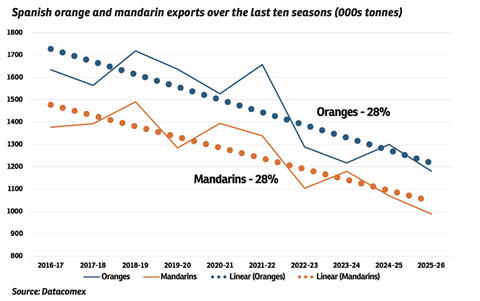
Between 2016/17 and 2020/21, orange production averaged 1.6mn tonnes a year. From 2021/22 to 2025/26, this had dropped to 1.3mn tonnes, and in the most recent season it reached just 1.18mn tonnes. In mandarins, Spain exported an average of 1.4mn tonnes between 2016/17 and 2020/21, while in the 2021/22-2025/26 period this had fallen to an average of 1.13mn tonnes – and in the most recent season, they didn’t even reach 1mn tonnes. It is worth noting that Spain first surpassed the 1mn-tonne mark in mandarins in 1990/91 and maintained that level right up to last season.
I have cited the structural problem of small-scale, fragmented landholdings as the primary cause of the decline in cultivated area in the Valencian Community; however, a more situational issue must also be added: the lack of proper organisation within the industry. Since 2008, the sector’s key coordinating body, Intercitrus, has been inactive. During this period, oranges recorded their worst drop in per capita consumption in Spain and Europe, while mandarin volumes remained broadly stable. Today, the organisation is being reactivated and has an ambitious programme for promotion, research, and sector advocacy. Let us hope it succeeds.
What’s in store for 2026/27?
On 15 September, the Ministry of Agriculture released the crop forecasts for 2026/27 aggregating all production zones. The data below compares these figures with the actual harvest from the previous season.
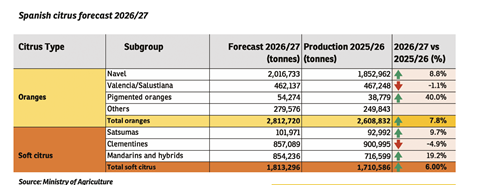
As we can see, the projected harvest is virtually identical to last year’s; indeed, when compared to the forecast made a year ago, the differences are minimal.
One of the most significant findings is that Spanish clementine production – which 20 years ago reached 1.6mn tonnes – has been cut almost by half. Meanwhile, hybrid varieties – led by proprietary cultivars such as Nadorcott, Tango, and Orri – are approaching the production volumes historically associated with clementines.
Recent rainfall and the resulting drop in temperatures are proving highly beneficial for the upcoming season in every respect. It is possible that Spain will halt the downward trend in orange and mandarin production, that Intercitrus will successfully ramp up operations, and that Spain will regain the top spot in citrus exports – a position it lost to South Africa last year after 175 years of leadership.