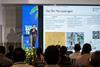
Strategies to fight the disease was the key theme at this year’s Banana Time Machala conference

Diane Mostert, speaking at this year's Banana Time Machala

Diane Mostert, speaking at this year’s Banana Time Machala

Image: Aebe

Some of the world’s leading experts on Fusarium wilt TR4 gathered in Machala, Ecuador last week for the fifth edition of Banana Time Machala, the Ecuadorean banana sector convention organised by the Association of Banana Exporters of Ecuador (Aebe).

The presence of TR4, currently considered one of the greatest phytosanitary threats to global banana production, was confirmed in Ecuador in El Oro province in December 2025.

Specialists Diane Mostert and Andre Drenth shared research highlighting the need to strengthen prevention and cooperation among producers, authorities, and research centres to reduce the impact of the disease.

They said the disease presents a challenge that cannot be addressed solely through scientific research or isolated public policies, but rather requires the active participation of producers, ongoing training, continuous monitoring, and institutional coordination.

South African researcher Mostert, a renowned expert in Fusarium wilt and the epidemiology of diseases in bananas, explained that TR4 is already present in 26 countries and warned that one of its main characteristics is its ability to remain in the soil for decades, which makes eradication extremely difficult. “Once TR4 arrives on a farm, it practically stays there forever,” she noted.

Despite its spread, there have been cases where the expansion of this fungus has been contained, such as in Mozambique, where the pathogen was detected on a commercial farm, prompting the implementation of strict biosecurity protocols, continuous monitoring, and movement controls.

Mostert also highlighted that 31 banana varieties are currently being evaluated in infected fields in Mozambique to identify materials with greater resistance to the pathogen and expand management options for producers.

Drenth, a plant pathologist and professor at the University of Queensland, pointed to the need to develop public-private partnerships and participatory surveillance systems for managing plant health threats.

Based on Australia’s experience with various agricultural diseases, Drenth emphasised that biosecurity represents a strategic investment for producing countries.

“The most economical way to control a disease is to not have it,” he said, explaining that the costs of managing the pathogen become permanent for producers and governments.

He calculated that keeping TR4 out of production areas in Australia generates benefits of approximately US$177mn annually for the banana industry. This Australian model of disease management is based on cooperation among producers, government agencies, universities, and research centres.

And while Australia’s experience demonstrates that containment depends on coordinated action among all actors in the production chain, Drenth acknowledged that levels of preparedness against Fusarium vary by region, especially in Latin America where social, economic, and political conditions are a significant factor.