Last April’s frosts may have slashed yields, but Moldova’s stonefruit exporters are capitalising on premium pricing and high EU demand
Two waves of late spring frost devastated cherry, plum and apricot yields in Moldova last year. However, export revenues had climbed to €230mn by November, surpassing 2024’s total of €222mn. Scarcity drove premium pricing and that more than compensated for reduced volumes.
Damage varied by crop. Cherries recovered to reach 16,000 tonnes, a modest increase from 15,000 tonnes in 2024. Plums held steady at 95,000 tonnes, while apricots collapsed to just 4,000 tonnes, down sharply from the 7,000-17,000 tonne range of recent years. Peaches suffered similarly, constraining fresh market supplies.
Despite lower volumes, export values surged. Cherry and apricot prices doubled, to €2,090 and €1,342 per tonne respectively. This premium positioning helped secure Moldova’s place in the global top 20 for plum, cherry and apricot exports.
By October, plum exports had reached 61,000 tonnes, on track to exceed 2024’s total by more than 10,000 tonnes. Cherry shipments totalled 12,400 tonnes, down from 13,600 tonnes, while apricots fell to under 4,000 tonnes from 12,000 tonnes the previous year. Plums alone generated €58.4mn in export revenue.
The EU remains the main market, absorbing the majority of Moldova’s stonefruit exports through duty-free access under the Deep and Comprehensive Free Trade Area. Germany saw imports from Moldova jump more than 50 per cent, while Romania and the UK remained key partners.
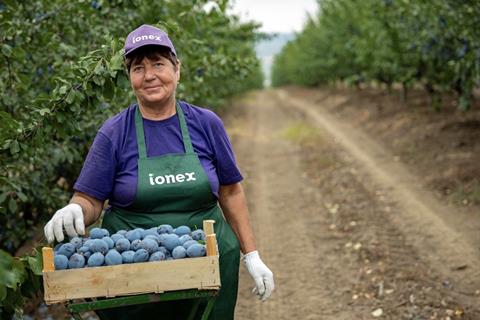
With both company-owned orchards and a network of partner growers, Ionex-Trans specialises in production, sorting, packing and export of stonefruit and table grapes, with an emphasis on quality, traceability and meeting international market requirements.
“Ionex is part of the broader community of Moldovan producers and exporters promoting Moldovan fruit on international markets, particularly in the EU,” explain Lidia and Ion Ionas, who lead the company. “We’re involved in joint initiatives related to promotion, standardisation and market access.”
The couple are candid about the difficulties of the 2025 season. “The season was complex and complicated for our company,” they note. “While overall fruit quality was generally good, volumes were affected by challenging weather conditions.”
Beyond the devastating spring frosts, the year brought periods of drought followed by weather instability. On international markets, Moldovan exporters are finding their footing in specific niches.
“Moldovan exporters continue to strengthen their presence on the EU market, particularly in niche segments where taste, freshness and delivery flexibility are valued,” Ion Ionas observes. “There are stricter quality and certification requirements, intensified price competition, but also more predictable relationships with established trading partners.”
The demand-supply balance proved volatile throughout 2025. “In some periods, reduced supply due to climatic factors supported prices, while at other times overlapping production from competing origins led to commercial pressure,” the Ionases explain. The EU import quota for plums, combined with oversupply from other producing countries, created additional downward pressure on export prices.
Is premium positioning the solution?
Moldova offers various forms of public support to its stonefruit sector, including subsidies, donor-funded projects and promotional initiatives. Programmes implemented through the Office for Entrepreneurship Development and the Moldova Investment Agency play important roles in facilitating access to financing, supporting modernisation investments and promoting exports.
“However, the overall effectiveness of public support remains mixed,” the Ionases admit. “While it contributes to investment and sector development, it is often insufficient to fully offset climatic risks and market volatility.”
Despite formidable challenges, including climate change, limited access to financing, labour shortages and rising costs, the Ionases remain optimistic about Moldova’s prospects as a stonefruit supplier, particularly for the EU market.
“Moldova is increasingly emerging as a promising supplier of high-quality stonefruit to the EU,” they say. “The country benefits from favourable agro-climatic conditions that enhance flavour and fruit quality, combined with proximity to major European markets, allowing for rapid and efficient delivery.”
What distinguishes Moldova, in their view, is the sector’s growing sophistication. “Local producers are demonstrating remarkable flexibility and a growing focus on quality, supported by significant investments in modern sorting and packing lines,” the Ionases note. “These advancements enable the production of premium fruit, carefully selected and packaged to meet the highest international standards.”
Through stronger cooperation across the sector and continued investment in post-harvest technologies, they say, Moldova can further leverage these advantages, enhancing its competitiveness and establishing “a strong, reliable presence on the European market in the years ahead”.
With EU backing through programmes like EBRD loans and support from the Moldova Fruct Association (which represents over 180 members and organises key promotional activities), the institutional framework exists to support this premium trajectory.
The 2025 season’s combination of frost-reduced volumes and premium pricing may well prove to be not just a temporary anomaly, but a glimpse of Moldova’s strategic future in European stonefruit markets. For companies like Ionex, the path forward is clear: invest in quality, build relationships with discerning buyers, and position Moldovan stonefruit where it can command the recognition and price it deserves.