Breeder said Pink Anita has been developed specifically for cultivation conditions in Mexico
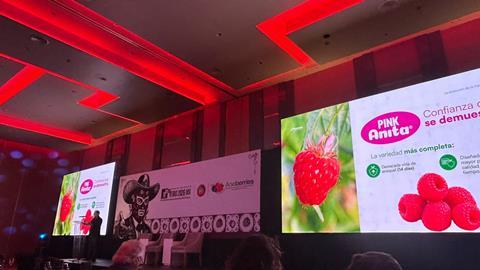
The 14th World Conference of the International Raspberry Organisation, held last week in Guadalajara, Mexico, was the backdrop for Planasa’s launch of its latest raspberry variety, Pink Anita.
Luis Bautista, Planasa’s head of product management, said the launch marked the milestone in the evolution of the company’s raspberry portfolio – from Adelita to varieties such as Pink Hudson, Pink Loira, and Pink Yaqui.
The breeder said it considers Pink Anita to be one of its most well-rounded varieties to date, combining high yield potential with “exceptional” fruit quality and a shelf-life of up to 14 days.
“These characteristics are intended to deliver tangible benefits: greater productivity and profitability for growers, as well as improved storage and commercialisation opportunities for stakeholders throughout the value chain,” the company said.
Bautista commented: “Genetics must provide the kind of confidence that is proven where it truly matters: in the field, in the producer’s profitability, and in the commercial windows for marketers”.
Planasa said the introduction of Pink Anita had already sparked significant commercial interest.
Planasa’s participation in the IRO also included the participation of Silvia Romero, a raspberry breeder for Planasa in Mexico, in a panel discussion titled ‘Designing the Raspberry of the Future: Varietal Innovation and New Technologies’.
During the event, Romero emphasized that genetic improvement must address challenges that go beyond mere productivity – such as resistance to pests and diseases, resource-use efficiency, adaptation to diverse growing conditions, and evolving commercial requirements.
“The future of the raspberry does not depend solely on developing better varieties, but on developing the specific varieties that the industry truly needs,” she said.
Pink Anita is now available, and through a series of field visits, the company will showcase the development and performance of this new variety – both in demonstration plots across Mexico and at its research centre in Jacona, Michoacán.