Serbian blueberry exporters have reason for optimism, says Pureberry director Radoje Đoković, with the outlook for the season looking encouraging
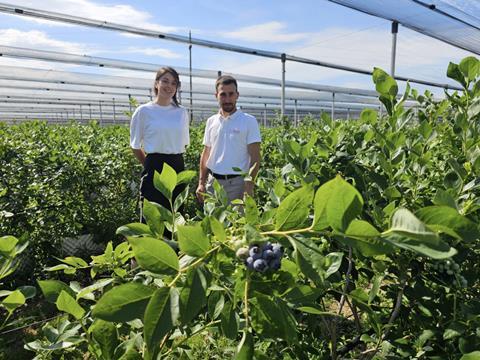
Serbia’s blueberry sector has a habit of getting on with things quietly. While the past two seasons have seen repeated frost events wreak havoc on cherries, apricots and plums across the country, blueberries – hardier and later to flower – have largely been spared the drama. Production has remained steady, quality has held up, and the industry has continued to grow its footprint in western European retail.
Radoje Đoković has a good vantage point on all of this. As director of Pureberry, one of Serbia’s more substantial blueberry operations, he oversees production across several agroclimatic zones, three packing lines running alongside two optical sorters, and Pure Logistics, the group’s own transport company. The setup gives him a clear view of the supply chain from orchard to retailer shelf, and his reading of the 2026 season is an optimistic one.
“Spring has passed without any significant frost, which is a good signal for the whole season,” he said. “Current indicators point to a very good crop in terms of both volume and quality. In blueberries specifically, we are expecting growth of around 15 per cent on 2025.”
The 2025 season was, by his account, a solid one – stable rather than spectacular. There was no pronounced peak to the harvest; volumes came through at a fairly even pace across the picking period. Favourable weather kept fruit quality intact. And with stonefruit in short supply due to frost damage elsewhere in the country, blueberry growers found themselves in a reasonably comfortable position on price.
“The average farmgate price in 2025 was around €1.25 per kilogram higher than in 2024,” Đoković noted, though he acknowledged that selling prices further down the chain did not rise by quite the same margin.
Filling the gap
Much of Serbia’s commercial logic in blueberries comes down to calendar. Duke and Draper, the dominant varieties, mature in the window between the end of the Spanish and Moroccan seasons and the start of the Polish harvest – a slot that Đoković described as “strategically very significant.”
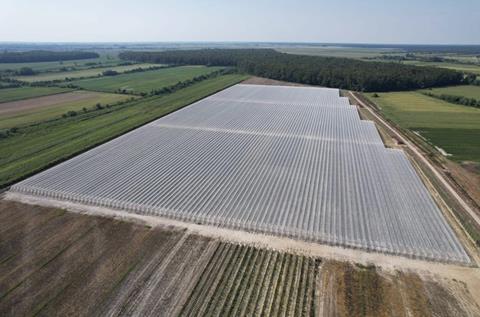
Poland is the obvious point of comparison for the latter part of the season. It is a large volume producer, but one that relies heavily on mechanical harvesting across extensive plantings.
“Poland enters the market at lower prices, but also with a different quality profile,” Đoković said. For retailers and importers looking for hand-picked, retail-ready fruit, the distinction matters.
Romania is a different proposition altogether. The two countries are already shoulder to shoulder in blueberry exports, and their harvest calendars overlap directly.
“Romania has developed into a real competitor, in the same way that Serbia once became a competitor to Italy through overlapping harvest windows,” Đoković said. Where Poland competes on volume and price, Romania competes on much the same terms as Serbia: quality fruit, similar timing, and an increasingly professional supply chain.
Built for the long haul
Serbian blueberry plantings have continued to expand, though the pace has come off the frenetic rate of four or five years ago when the crop was something of a gold rush. For Pureberry, the slower growth of the supply base is not a concern. The company has its own production across different growing zones to buffer against localised variation, and a long-established grower network that Đoković credits with providing real continuity.
The packing operation is built to handle volumes well above current throughput: seasonal capacity runs to around 2,000 tonnes, of which roughly 75 per cent is currently utilised. Pure Logistics handles the cold chain end to end, which Đoković sees as increasingly non-negotiable for western European trade. “Distributors today want a finished, quality-produced and packaged product,” he said. “It is a wonderful thing to place such a product with European buyers under the label ‘Produced in Serbia’ and, in doing so, represent our country in the best possible light.”
Not everything is straightforward though. Geopolitical turbulence – the ongoing war in Ukraine, disruption around the Strait of Hormuz – has fed through into input costs in ways that Serbian producers feel acutely. Plastic packaging is one pressure point; energy and fuel are others.
“These affect overall production and logistics costs,” Đoković said. His response is pragmatic: “Market mechanisms function – trade adapts, and products find their way to customers, with a somewhat higher level of operational flexibility required.”
Demand, at least, continues to move in the right direction. Blueberry consumption is growing on both export and domestic markets, even if weekly offtake fluctuates with the availability of competing summer fruit – strawberries, cherries, raspberries and watermelons all take a share of the seasonal fruit basket. What has not fluctuated is the standing of Serbian blueberries among western European retailers.
“Serbians blueberries have already secured a stable position based on quality,” Đoković said, and the company’s core markets, Germany, France, the Netherlands and the UK, reflect that.
For buyers doing their summer planning, Đoković’s message is simple. “Expect a stable supply of quality blueberries from Serbia,” he said. The first shipments to European markets are planned from week 24, in line with the standard Serbian harvest window.