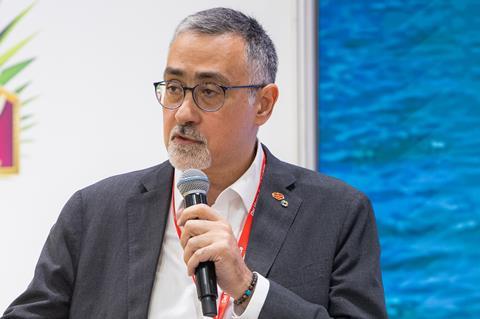
Del Monte president Mohammed Abbas addressed the evolving challenges of international trade at the Global Produce & Floral Show
International fresh produce operators are identifying the need for more flexibility and diversity of both supply and markets to keep them nimble in a complicated global trade environment.
That was a key takeaway from Mohammed Abbas, president and COO of Del Monte, in conversation with IFPA global chief policy officer Alexis Taylor at the Global Produce & Floral Show in Orlando, Florida.
Abbas began by explaining that the Covid pandemic was the trigger that “shifted globalisation to regionalisation and localisation”. “We were all working under the assumption that there’s free trade across the world, but when Covid hit it shook that norm and we started thinking differently – different sourcing, different planning, different shipping routes,” he said.
“Even governments started thinking of localisation because of banning certain products from entering or leaving countries. Food security took that priority.”
Abbas, who refused to be drawn on politics, said that tariffs are only one element of what is a complicated trade picture in 2026 – one that also includes challenges around MRLs, packaging and shipping.
Such issues have to be considered when weighing up where to set up farms or establish sourcing pipelines, meaning that flexibility – or “optionality” as Abbas described it – is something Del Monte is now looking for in any new investments or expansions.
Trade is no longer just about sourcing either, but is also about markets, he continued. That means that if you’re building a network of global customers, you need to have options of where to sell in the event of, for example, sudden high tariffs.
“It’s not only a US issue, it’s a global issue,” he insisted. “[If] sourcing bananas or pineapples from the Philippines became restricted because of a high tariff, then you have another origin like Vietnam, Cambodia or Laos that becomes an option. You need to build that different sourcing strategy. But then what do you do with the product from the Philippines? Since you have that trade barrier, you need other markets globally to reach out to.”
In the context of a projected food shortage as the global population rises, Abbas argued that farmers shouldn’t think of other producers as competition, but as “a solution for feeding the world”. “That’s the higher value we operate under,” he added. “Not just how to make profit here or there, but a bigger thought, and for that we need to build optionalities for the future and continue to evolve in how we think.”
Given his key message, it was unsurprising that Abbas named adaptability as a key tenet of successful modern fresh produce businesses, with agility as another. That said, he argued that companies should not just “shoot from the hip” and react too quickly in the face of any political event. “We need to have a cool head,” he stressed. “I’m not saying wait for weeks or months, but at least think of a solution to it.”
Abbas pointed to IFPA’s Advocacy Action Network as having a crucial part of play in helping businesses navigate the many factors at play. The network gives members the tools to contact policymakers and stand up for the industry’s interests.