After last year’s especially challenging weather in Turkey, producers feel fortunate at the lack of hail and heavy rain – but big challenges remain
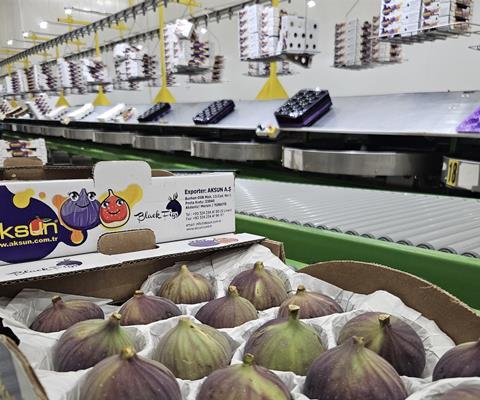
Among fruit lovers, few seasons are welcomed with as much sensory anticipation as figs. Their fragility and preference for shorter journey times mean they remain relatively seasonal for most shoppers.
In Europe, where Turkish figs dominate the market, the start of the season in mid to late August is highly anticipated by many, and comes as a welcome annual surprise to most of the rest.
“Harvesting started on 20 August this year,” reveals Akin Söyleyen, marketing manager at Turkish exporter Aksun. “We have good supplies right now, and the season should stretch to the end of October.”
After last year’s decidedly inclement conditions, growers can hardly believe their luck this year. “The weather conditions were kind of a problem last year,” recalls Söyleyen, “but this year we’ve been lucky. When it comes to figs, as well as citrus and apples, supplies are fantastic. We didn’t have any hail, heavy rain or excessively cold or hot temperatures, so everything’s looking good right now.”
Turkey faces competition from several fig-producing origins, including Spain, Greece, Italy and Egypt, depending on the market and timing of the season. However, Turkish figs remain distinctive thanks to their large size, appearance and strong availability.

“We have a different variety in Turkey,” notes Söyleyen. “Our figs are very big and have quite a different appearance. There can be overlap with other origins, but since supplies are good, there shouldn’t be a problem.”
Aksun is mostly focused on Europe, as well as Canada, Japan, Singapore, Malaysia and Hong Kong. “For our figs, we send to places like Canada, Singapore and Hong Kong by air,” reveals Söyleyen. “We can send quite a lot to Hong Kong, all by air. To Europe the figs go by truck. Demand from the UK is good and promising, and it remains an important market for figs.”
Labour availability remains one of the key challenges for Turkish companies, particularly for citrus, one of the more labour-intensive categories handled by Aksun.
“Labour is an issue, which is why we have invested in a new citrus packing line,” explains Söyleyen. “The system helps us reduce the amount of manual labour required, while supporting higher quality and greater volumes.”
Logistics is yet another challenge given the continuing crisis in the Gulf. “For the last couple of years, the Red Sea has been an issue, and it still is,” he admits. “We used to have four or five different shipping lines passing through Suez, providing competition and lots of choice. Right now, there are only one or two, so prices have gone up.”
Continuing political tensions around the Black Sea have also created hurdles for Turkish exporters targeting Russia, with many considering alternative markets due to the additional uncertainty.