Shipments jump 46 per cent to 60,000 tonnes in first quarter of 2026, as focus shifts to quality not quantity
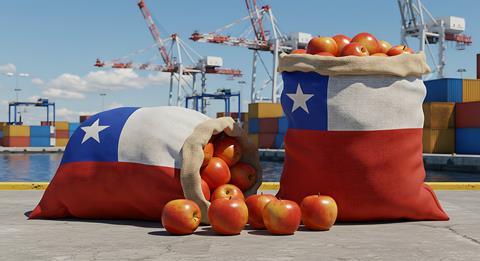
Chilean apple exports grew 46 per cent year-on-year in the first quarter of 2026 to more than 60,000 tonnes. The data, from the Office of Agricultural Studies and Policies (Odepa), show shipments increased by 27 per cent compared to the average of the last five quarters between 2021 and 2025.
While this marks a significant recovery from last year, in which Q1 exports barely exceeded 36,500 tonnes, shipments are still well below pre-2020 levels. In the first quarter of 2017, for example, exports exceeded 91,000 tonnes.
According to analysis by Más Producción, the Chilean industry has undergone a major structural transformation in recent years. Producers have responded to changing consumer preferences with varietal renewal, improved production standards, and a more selective commercial strategy: It is no longer simply about exporting more, but about exporting better.
This is reflected in the increase in export values – in the current season, the average FOB value reached US$1.11/kg, representing an 8 per cent increase on 2025 and a 14 per cent increase compared to the average of the seasons between 2021 and 2025.
“This phenomenon reflects a qualitative shift in the exportable supply: better varieties, greater uniformity, improved post-harvest characteristics, and a strategy geared toward markets willing to pay more for quality,” Más Producción noted.
Since the start of the decade, the Chilean industry has been replacing traditional varieties with others that are more in line with international demand. “These new varieties not only offer better flavour and appearance, but also a longer shelf-life and greater resistance to transport – key factors for competing in distant markets,” Más Producción said.
“This change has allowed Chilean apples to improve their positioning in higher-value segments, partially offsetting the decline in volume compared to previous years.”
Analysis of destination markets also reveals some interesting new developments. During the first quarter of 2026, Colombia was the top market, taking 17,400 tonnes, followed by Ecuador with 9,400 tonnes. Both markets have historically been key partners for Chilean apples, thanks to their geographic proximity and established trade relationships.
However, India has now emerged as the third largest destination, taking 6,100 tonnes of Chilean apples in the first three months of this year. This is an emerging market that is rapidly gaining importance, driven by the growth of its middle class and the opening to fresh fruit imports. In 2017, the third largest destination was Saudi Arabia.
Another relevant fact is the reduction in the number of destination countries. In the first quarter of 2017, Chilean apples reached 49 markets. By 2026, that number had fallen to 40.
“At first glance, this could be interpreted as a loss of diversification. However, a deeper analysis suggests the opposite: a greater concentration on more profitable and strategic markets,” Más Producción stated. “In 2017, the ‘other destinations’ group represented approximately 60 per cent of total exports. By 2026, that proportion had fallen to 40 per cent, indicating a greater focus on key markets.”
Despite this reduction, diversification remains high compared to other exporting countries, which constitutes a structural strength for Chile.
“If conditions are favourable, 2026 could mark not only a recovery but also the consolidation of a new paradigm for Chilean fruit growing. A stage in which the key will not be how much is exported, but how and at what price,” Más Producción concluded.